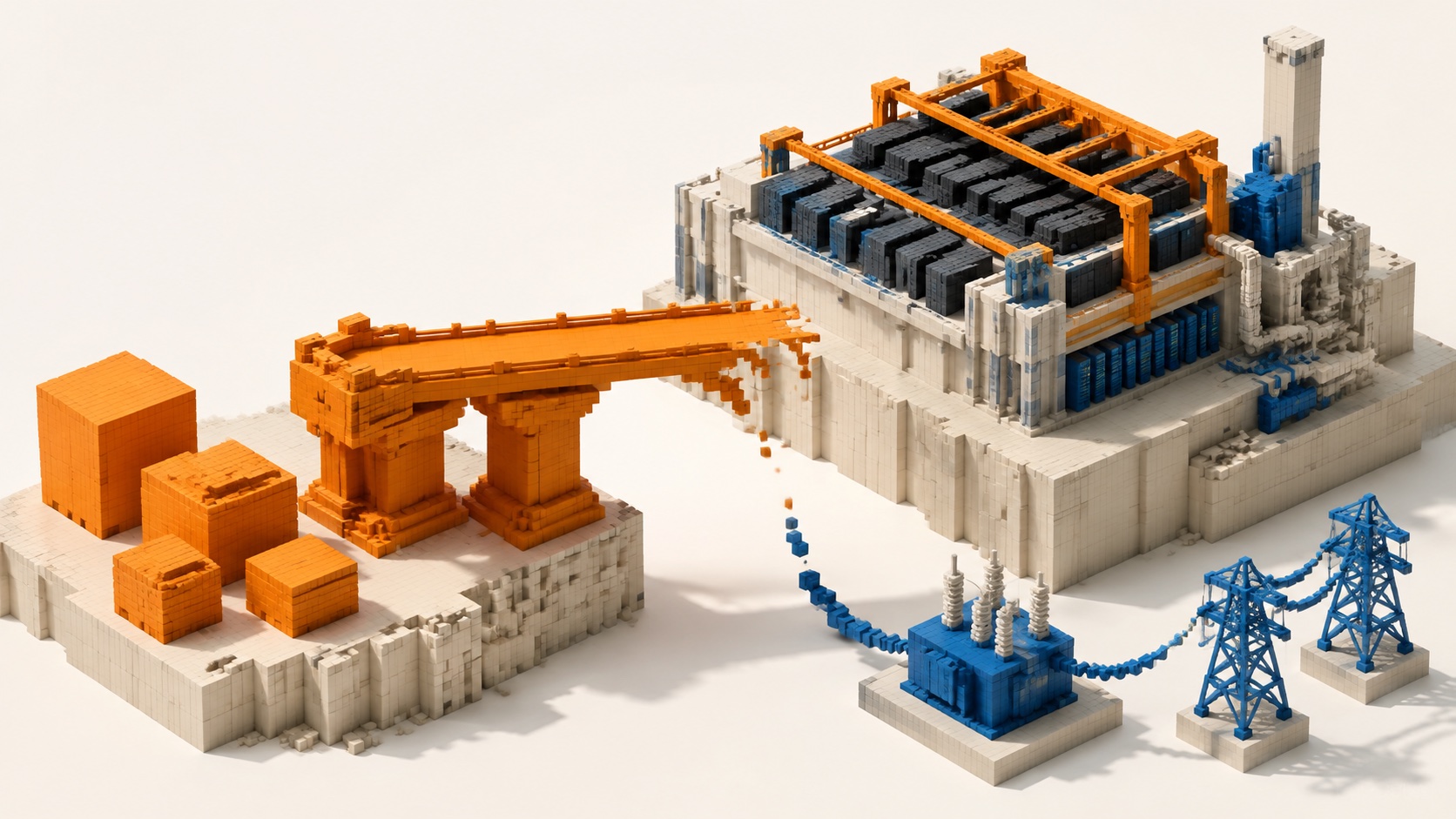
NVIDIA's August 10 memorandums with Apollo, BlackRock, Blackstone, Brookfield, Goldman Sachs and KKR target more than $500 billion of third-party capital over time through independent platforms. Final agreements remain to be executed. The figure is an ambition, not cash already received or equipment revenue already delivered. [1]
More funding channels matter because equipment, power and facilities require investment before customer payments begin. Developer equity may not cover the timing gap. But additional finance can reduce capital costs while also enabling competing supply. Returns depend on who receives funds, which cash flows support them, and what remains after necessary payments.
In this article7 sections
The announcements describe different stages of financing
NVIDIA has not disclosed project commitments, collateral, terms or draw conditions for each platform. Institutional participation indicates willingness to develop the asset class. Assets under management are not funds available for these projects, and the target cannot be divided mechanically among the six partners. [1]
Apollo's June 9 Broadcom AI XPV transaction is more specific: an initial $35 billion capital solution with committed financing across a multi-year draw schedule, supporting Anthropic's previously announced expansion of more than 1GW. It is closer to executable financing, but does not mean all capital has been invested or that the wider platform belongs to the first transaction. [2]
Managed assets, fund commitments, project facilities, drawdowns and equipment deliveries describe different things. A funded vehicle may still be unable to draw for a project lacking contractual or construction conditions. Drawn cash may precede acceptance. Revenue and free cash flow follow their own contracts and periods.
Legally committed capital, first draws and identified collateral provide more direct earnings information than another institution joining a platform. Both matter, but they should not receive equal weight in a profit forecast.
Lenders underwrite repayment, not computing capability alone
A GPU can provide compute without generating enough cash for principal and interest. Lenders need to know who pays, whether minimum payments can be cancelled, what delivery is required and who pays when service stops. An enforceable contract connects customer credit to the financing.
Purchase price, book value and default recovery are different collateral measures. Disposal may require removal, transport, redeployment and software work. Cheaper new equipment can depress used prices. Collateral cushions losses without replacing recurring cash generation.
Land, buildings and accelerators have different economic lives. Debt should not be justified solely by the longest-lived asset. A usable building can contain equipment needing replacement to compete. Assuming persistently high rents for old GPUs can expose both service receipts and recovery values to technical progress.
Project structures allocate completion exposure, customer payments, specific supplier support, senior cash claims and equity residuals. The actual allocation requires documents. No undisclosed guarantee is assumed here.
Cheaper debt can lift cash returns—and leverage cuts both ways
Consider an illustrative $1 billion project funded with $600 million of debt and $400 million of equity, producing $100 million of annual cash before interest. Interest-only debt at 8% costs $48 million, leaving $52 million; at 6% it costs $36 million, leaving $64 million.
| Illustrative case | Annual interest | Cash after interest |
|---|---|---|
| $100m operating cash; $600m debt at 8% | $48m | $52m |
| Same cash and debt at 6% | $36m | $64m |
| $70m operating cash; debt at 8% | $48m | $22m |
The two-point reduction adds $12 million and increases the simple post-interest cash return on equity from 13% to 16%. This excludes principal, tax, replacement investment and reserves and is not an IRR. Actual distributable cash would need those further deductions.
If operating cash instead falls to $70 million, interest at 8% leaves $22 million, roughly 57.7% below the original $52 million. A 30% operating decline creates a much larger decline in the equity residual. More debt can reduce initial equity while amplifying downside.
Lower rates and higher leverage should therefore be assessed separately. Better underwriting and lower transaction costs can improve financing efficiency. Additional debt used to compensate for weak operating economics provides a thinner cash buffer, even if the initial equity cheque shrinks.
Construction and operation need different financing
Before operations, lenders focus on completion and budget. Contingencies, equity support, procurement and acceptance terms affect access to funds. A large undrawn commitment can indicate remaining conditions and obligations rather than readily spendable cash.
Once operating, collections, service costs and equipment competitiveness become central. Fixed availability payments may leave short-term usage risk with the customer. Usage-based sales expose the operator directly to utilization. They do not justify identical debt assumptions.
Draw timing also matters. A $1 billion facility fully drawn at the start of a year at 8% would incur $80 million of nominal annual interest. An average drawn balance of $500 million at the same rate would incur about $40 million, before commitment fees and other costs. The headline facility size is unchanged.
Receipts occur at different entities. An equipment supplier collecting cash does not establish that the project is profitable; equity raised by a cloud customer does not prove final applications cover procurement. Following the money prevents finance, intermediate sales and end demand from being added together.
More capital changes bargaining power across the chain
Funding can accelerate equipment purchases while enabling competing cloud capacity that later pressures rental prices. A sales opportunity for a supplier need not produce the same benefit for a cloud operator's shareholders. Price, utilization and cost determine the allocation.
Financial institutions may earn management fees, arrangement fees or investment returns. Estimating their profit requires the fee base, rates, deployment and expense responsibilities. Multiplying the platform ambition by an assumed fee does not establish incremental earnings.
Customers may receive some financing savings through lower compute prices and broader viable applications. Power or equipment scarcity can limit that pass-through. Capital cost is one component alongside energy, depreciation, efficiency and support.
The counter-case is that additional money chases the same customers and equipment, lifts procurement costs and relaxes underwriting. Different fund names do not diversify a common payment source. An apparently broad financing market can remain concentrated in a few end customers.
Safer senior debt does not make the whole project more profitable
Senior debt, junior capital and equity can allocate different loss positions in the same asset. Strong protection can lower senior interest without creating more project cash; it may simply leave volatility with junior investors. Funding success needs both a price and a risk-allocation assessment.
If an asset falls from 100 to 80 with senior debt of 60, equity and other junior capital absorb the 20 decline while senior coverage remains. If value falls to 50, senior claims may face a shortfall too. This static example excludes disposal costs and interim cash, illustrating how securities in one asset can perform differently.
An asset manager may arrange, manage and invest in the same transaction. Closing fees and long-term fund gains need not accrue to the same investors. Separate arrangement income, recurring management fees and actual proprietary capital at risk.
For suppliers, enabling independent financing differs from offering repurchase, price or credit support. The latter can leave obligations after equipment delivery. The platform announcement does not disclose every contract, so neither absence nor existence of guarantees should be inferred from partner reputation.
All-in funding cost also includes arrangement and commitment fees, reserves, hedging and equity requirements. A low coupon with substantial idle reserves need not be cheaper than a slightly higher rate with well-matched draws.
Financial innovation is most useful when it matches duration, assets and risk preferences for a sound operating project. If customer cash cannot cover maintenance and replacement, security design reallocates losses without repairing the underlying economics.
The next contract matters more than the aggregate target
Executable payment obligations, phased power and delivery, budgets, overrun support, debt schedules and replacement responsibilities would strengthen the case. They show that funding can enter productive assets at appropriate terms and be repaid from customers.
Delayed drawdowns, hardware arriving before power, weak payment protection or returns requiring more leverage would weaken it. Industry demand can grow while individual projects deliver disappointing returns.
The partnerships create an opportunity to broaden the financing market. The investment value of the $500 billion ambition will emerge from projects that draw capital, deliver service and collect cash. Sustainable residual cash is the shareholder outcome to measure.
Sources
This website is for information and research only and does not constitute investment advice.