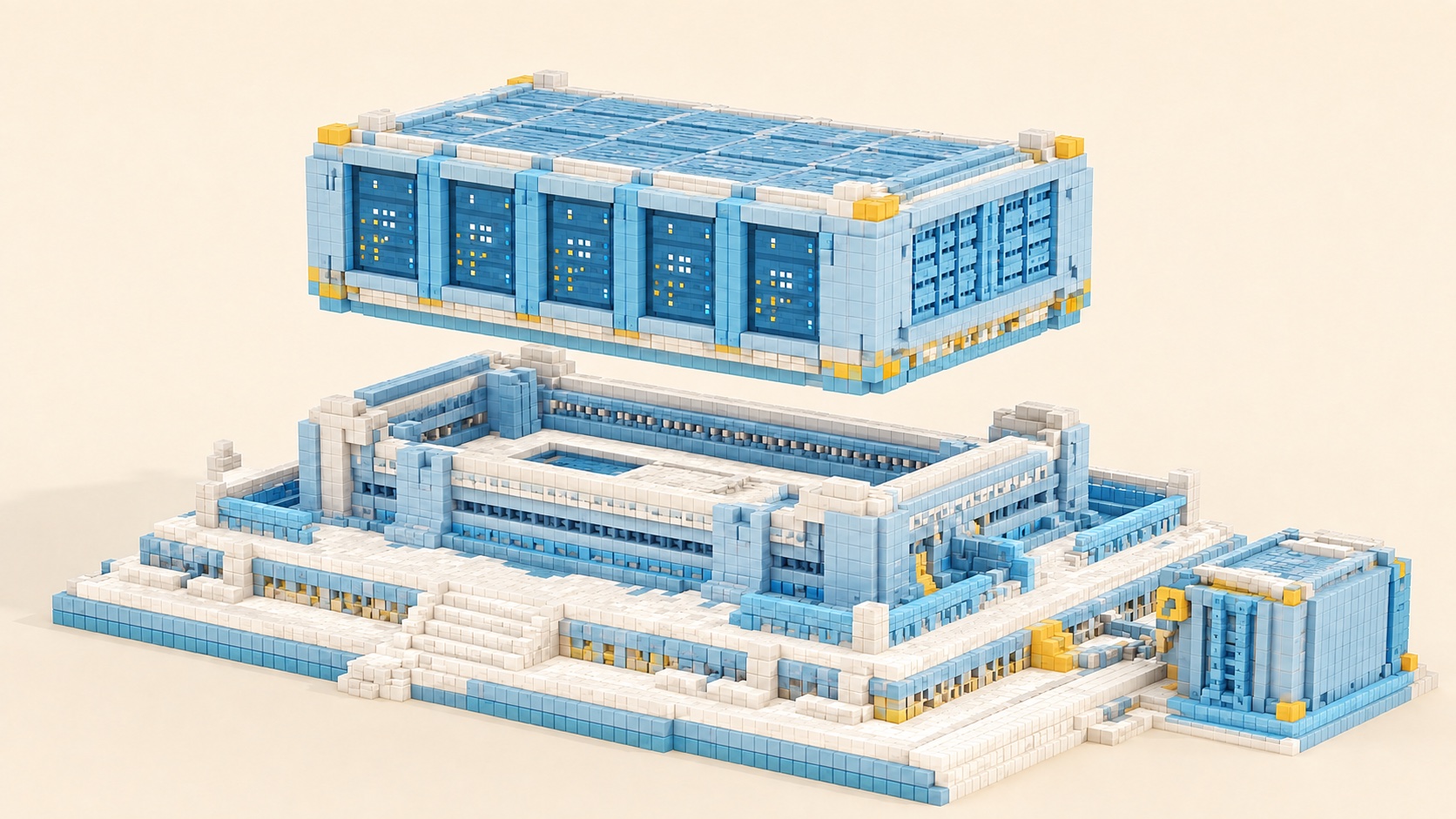
Nebius's July infrastructure partnership model and its $775 million secured loan address the same constraint through different mechanisms. Partners fund assets; the loan converts deployed GPUs and contracted receipts into cash available for further expansion. Both can reduce dependence on new equity. [1][2]
They also make revenue growth a less complete measure of shareholder economics. A dollar of cloud sales may come from owned equipment, committed capacity, a revenue share or a licence. Capital requirements and retained liabilities differ. The next test is whether Nebius can preserve service quality and profit while reducing the assets it must finance itself.
In this article6 sections
The partner owns the equipment; Nebius sells the service
The July 15 announcement assigns financing, hardware ownership and facility operation to partners. Nebius supplies architecture, supply-chain access, its technology stack and global sales. Proposed economics include revenue sharing, licences, commissions and committed capacity, which are materially different contracts. [1]
A licence may generate relatively little reported revenue without the burden of equipment capital. Buying committed capacity for resale can retain more revenue but leave the platform paying a partner when customer demand is weak. Both fall under the partnership label. Falling fixed assets or a rising gross margin would not reveal the minimum-purchase obligation.
Customers still buy Nebius cloud services. Nebius retains responsibility for software and service levels, while partners manage facilities and hardware. A customer's compensation claim and Nebius's recovery from a partner may differ in size and timing. Transferring ownership does not automatically transfer the consequences of service failure.
The platform's premium depends on improving utilization, reliability or access to valuable customers. A one-time sales introduction provides limited bargaining power at renewal. Scheduling, storage, developer tools and enduring customer relationships offer a stronger basis for retaining profit.
A higher margin can accompany lower gross profit
Consider an illustrative customer spending 100 units annually. An owned model incurs 70 units in facility costs, depreciation and direct services, leaving gross profit of 30, against an assumed 200 units of equipment capital. A partner model charges a 20-unit service fee and incurs five units of platform costs: gross profit is 15 and gross margin 75%. The percentage improves from 30%, while gross profit halves.
If the partner model needs just ten units of initial investment, lower gross profit can still produce better capital efficiency. But substantial capacity prepayments or a guaranteed partner return could raise that investment. These figures illustrate the distinction; they are not estimates of Nebius's fees, costs or accounting presentation.
Useful comparisons include incremental equipment spending, prepayments and deposits per additional dollar of gross profit, alongside the gap between customer collections and partner settlement. Comparing net licence revenue with gross owned-cloud revenue can confuse a change in business model with a change in demand.
Partner-capacity disclosures would therefore be more valuable if accompanied by revenue, service costs, minimum obligations and availability. More funding channels are evident; improved group free cash flow still needs demonstration. Accounting ownership and economic exposure require separate analysis.
The loan is backed by assets already serving a customer
The July 17 facility is supported by deployed GPUs and investment-grade contracted cash flow. It matures on October 31, 2030 and is priced at SOFR plus 2.50%. Nebius says the facility and customer cash flows together cover more than the underlying GPU capital expenditure. That does not mean the bank alone lends more than the equipment cost, or that equity was unnecessary. [2]
An operating asset gives lenders more evidence than a construction plan: equipment exists and a payment basis can be reviewed. Transferability, service deductions and collateral enforcement still determine how much of the contract value can support debt.
At an unchanged $775 million balance, a one-percentage-point SOFR increase would add $7.75 million of annual nominal interest, before hedging or other offsets. No estimate of current SOFR is needed to show this sensitivity. Repayment would reduce it as the outstanding balance falls.
A 2030 maturity does not establish that no principal is repaid earlier. The announcement does not provide a full amortization schedule, so a precise debt-service coverage ratio or a single final balloon cannot be assumed. Recycling funds into new growth leaves the old asset responsible for its own financing obligations.
$40 billion of contracts is not a borrowing base
Nebius cites more than $40 billion of additional investment-grade contracted revenue as a basis for similar financing. Those receipts span periods. Borrowing capacity also depends on delivery, service costs, required coverage and enforceable collateral value. Customer credit is only one input. [2]
A higher lender discount or equity requirement can reduce proceeds even when customer names remain unchanged. Growth then requires more company capital before revenue necessarily weakens. The first facility's pricing cannot simply be copied into every future expansion.
Cash released against collateral is financing, not profit. Reinvesting it expands both capacity and debt. The cycle can accelerate growth when old contracts cover principal and interest; delivery delays, rising service costs or stronger competition from new hardware can leave the company supporting old obligations and new construction together.
Assess each asset cohort: service status, remaining contract duration, debt balance and responsibility for replacement. Strong contracts aligned with debt repayment can improve equity efficiency. Debt extending beyond competitive service economics makes residual value a more important assumption.
Put the customer and partner on one monthly cash schedule
A frequently missed cost is the gap between partner availability and customer billing. If Nebius pays a fixed capacity charge from availability while its customer is still installing and testing, it bears costs without corresponding receipts. Off-balance-sheet ownership does not remove the contractual cash payment.
Consider a hypothetical $10 million monthly minimum capacity purchase, $15 million of revenue at full sales and $2 million of other direct service costs. Full sales leave $3 million of contribution. Revenue at 70% with other assumptions unchanged leaves a $1.5 million loss. This illustrates operating leverage, not actual Nebius terms.
Revenue sharing can distribute ramp risk between platform and partner, but the partner may require a higher share. Refunds, credits and bad debt still need allocation. The appropriate structure depends on confidence in demand, rather than a preference for an asset-light label.
Customer advances improve current cash while creating future service obligations. Investing those receipts elsewhere does not eliminate the capacity and cost required to fulfill the original contract. Cash quality must be considered with deferred revenue, budgets and available resources; advance receipts are not freely distributable earned profit.
Partner financing is an indirect service dependency. Failure to finish or maintain a facility can force migration, replacement purchases or reputational loss. Absence of a direct mortgage obligation does not guarantee that commercial support will never be rational.
The strongest outcome is specialization: partners supply durable capital while Nebius improves asset productivity through software and customers. Repeated delivery cohorts must show platform profit is not offset by prepayments, minimum commitments and service compensation before the model’s per-share advantage is established.
Power and operational control determine scalability
The partner model coexists with owned expansion. Existing disclosures include up to 1.2GW in Pennsylvania, phased delivery from 2027, an end-year connected-power expectation of 800MW–1GW, and a plan for 328MW of Bloom behind-the-meter fuel cells in 2026. These represent different scopes and forward plans, not a combined inventory of usable IT capacity today. [3][4]
Onsite power can reduce dependence on some transmission work, but fuel supply, maintenance, emissions requirements and backup arrangements still shape cost. Nameplate generation is not usable IT capacity. If fuel-price risk stays with Nebius, earlier revenue can come with more volatile service costs.
Across partners, inconsistent upgrades, recovery or network performance can damage the customer's view of the whole platform. Monitoring and correcting those differences requires operating expenditure. A software package alone cannot deliver uniform service across independently owned facilities.
Over 12–36 months, the favorable case requires delivered partner capacity, stable retention and less cash invested per incremental dollar of gross profit. Minimum commitments outrunning sales, service compensation, rising prepayments or wider debt spreads would weaken it. The advantage must ultimately appear as sustainable profit supported by less shareholder cash.
Sources
This website is for information and research only and does not constitute investment advice.