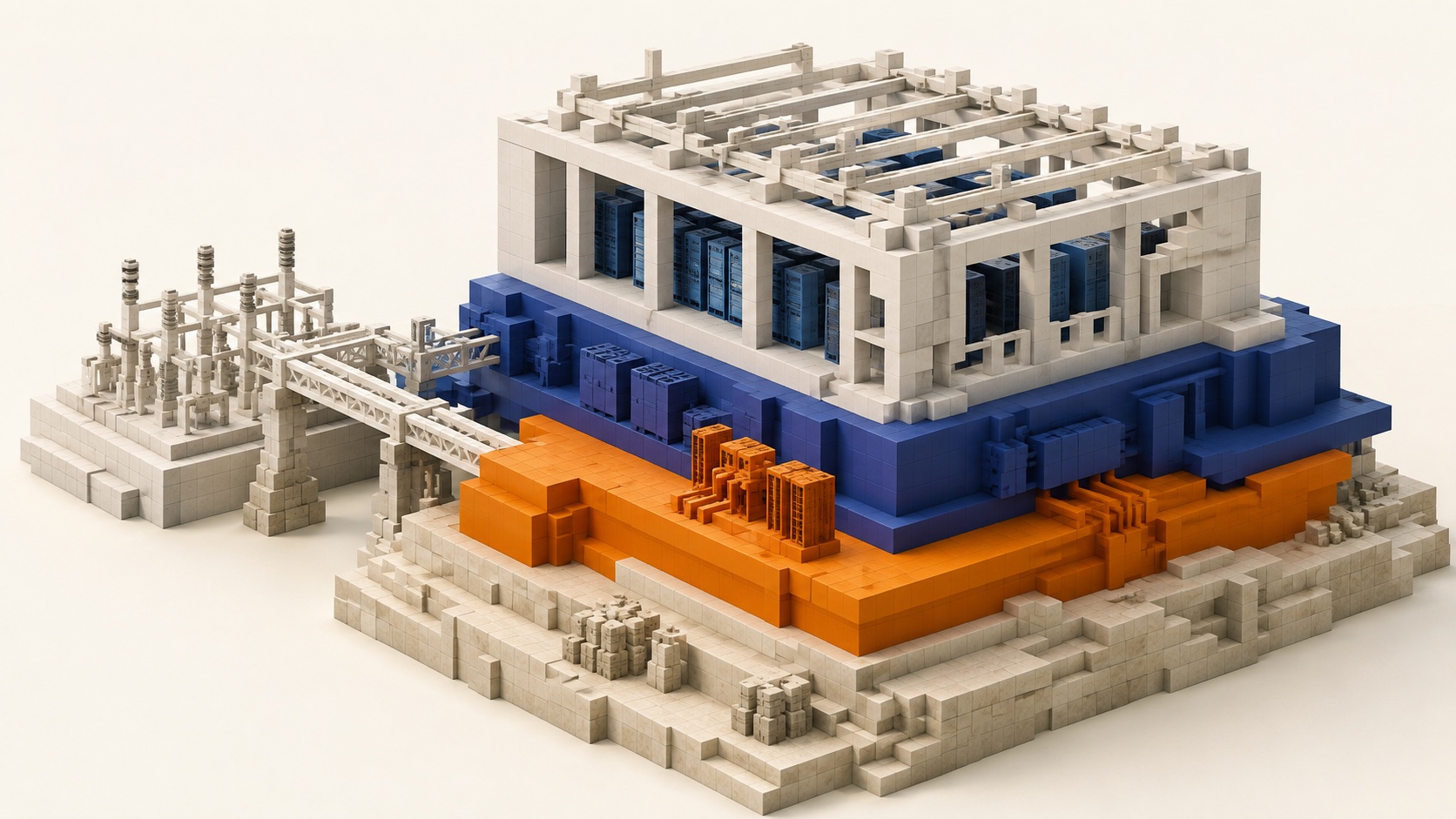
NVIDIA plans to invest $1.5 billion in SB Energy and provide credit support for the land, power and shell supporting the first 4.25GW of IT capacity at PORTS-Pike in Ohio. The campus is planned for 8GW and will exclusively use NVIDIA's computing platform. The supplier is using capital and credit to help create a market for its systems, while taking exposure beyond an ordinary equipment sale. [1]
The August 17 announcement says SB Energy will build, own and operate the facility under a 20-year lease to OpenAI. Capacity is expected to arrive in phases from 2028; NVIDIA holds an option on the remaining 3.75GW. The lease establishes a time horizon. Undisclosed minimum payments, credit-support triggers and termination rights will determine how much can be borrowed and who pays when demand or construction disappoints. [1]
In this article6 sections
A long lease addresses only part of demand risk
OpenAI buys access to infrastructure. SB Energy seeks to recover development capital from rent. NVIDIA gains a route to system sales through platform exclusivity. Lenders require part of the resulting cash to service debt. These transactions belong to one production chain; counting each as separate final demand would multiply the same economic activity.
A 20-year facility relationship can span several generations of accelerators. That creates potential repeat sales, but future systems still need to justify their economics. Exclusivity does not disclose the price, quantity or margin on each replacement cycle and cannot turn prospective upgrades into revenue today.
A landlord's receipts depend on the lease's availability and acceptance provisions, while the tenant's return depends on monetizing compute. Under a fixed payment obligation after qualified delivery, low utilization could first hurt the tenant without reducing rent. The public announcement does not establish the precise minimum-payment mechanism here.
Cheaper funding comes with a contingent liability
NVIDIA's support covers land, power and shell for the initial 4.25GW. Its legal ceiling, duration, recourse and collateral priority are undisclosed. The $1.5 billion equity investment is an identifiable commitment, but it cannot be treated as the maximum exposure to the overall arrangement. [1]
A lender needs enforceable protection before assigning much value to support. Completion support may offer limited protection against a later customer default; payment support can expose its provider to cash obligations when the customer struggles. These illustrate possible structures, rather than describe clauses that have not been published.
The commercial benefit also needs its own calculation. Lower financing costs may bring the campus into service earlier and accelerate profitable system deliveries. But if support obligations are large relative to equipment margins, sales profit may provide inadequate compensation for tail losses. Neither headline capacity nor the equity cheque measures that trade-off.
For illustration, a one-percentage-point reduction in the interest rate on $10 billion of debt saves $100 million annually, assuming an unchanged balance and excluding fees. Actual debt, pricing improvement and allocation of savings have not been disclosed. The saving accrues to the project; a potential support payment may accrue to the supplier. Those are different economic positions.
Capacity needs a schedule of accepted tranches
The initial 4.25GW represents about 53.1% of the planned IT total. The remaining 3.75GW represents 46.9% and includes an option. It should not receive identical treatment to the initial supported scope. Even the first phase depends on generation, substations, buildings, cooling, system installation and acceptance.
The release anticipates phased operation from 2028 and says SB Energy and SoftBank will build at least 10GW of new generation and invest at least $4.2 billion in regional grid infrastructure. These are prospective commitments. Dividing generation nameplate capacity by IT load would not establish measured PUE: availability, reserve capacity and electrical boundaries differ. [1]
At least three cash schedules matter. Equipment delivery may precede actual use. Facility acceptance may start rent. OpenAI's receipts depend on its own sales. Prepayments, reserves or equity must fund mismatches. A broadly advancing campus can still suffer a temporary cash deficit because one critical component delays a particular tranche.
Consider an illustrative $5 billion already invested at an 8% annual financing cost. An extra six months represents roughly $200 million of capital carrying cost. The effect would be smaller if spending had not yet occurred or customer payments continued; rework and storage could make it larger. The value of time depends on actual capital deployed and receipt dates, not just megawatts.
Replacement hardware and reletting are separate risks
A building can remain useful after an accelerator generation becomes uneconomic. New systems may improve revenue per unit of electricity, but can require denser racks, different cooling interfaces and electrical work. Ownership of the GPUs, responsibility for upgrades and rent during downtime determine who benefits from the long lease.
Equipment resale and facility reletting provide different recovery routes for creditors. An ability to sell used GPUs does not guarantee a replacement tenant for the campus. Another customer may need a different network, security configuration or deployment schedule. Conversely, a facility with mature power and mechanical systems can retain value through hardware changes; chip obsolescence does not imply a worthless building.
Platform concentration simplifies some design and operating decisions but reduces the customer's supplier options. The value of better systems, support and delivery certainty has to be weighed against this constraint. Credit support may partly compensate a customer for accepting exclusivity, although the public terms do not permit that value to be measured.
The strongest favorable reading is that demand, development capability and system standards can be coordinated, avoiding repeated design and financing delays. The adverse reading is that demand, finance and equipment sales increasingly depend on the same group. Weak cash generation at one participant could affect investment value, rent and orders simultaneously.
Compare incremental platform profit with retained exposure
NVIDIA may earn equipment, upgrade, software and service profits while its $1.5 billion equity investment participates in SB Energy’s residual value. These returns have different timing. Equipment profit can arise at delivery, equity value may take years to realize, and credit support can demand cash at an unfavorable moment. One announcement does not align their risks or maturities.
Suppose, purely illustratively, support enables $10 billion of additional equipment sales at a 50% gross margin, producing $5 billion of gross profit. A $2 billion net support payment in a stress case equals 40% of that gross profit; $5 billion equals all of it. No default probability, PORTS-Pike pricing, actual margin or payout is assumed. The example explains why exposure limits and recovery matter alongside orders.
A guarantee payment need not equal ultimate loss. Recourse or acquired assets could provide later recovery, but realization takes time and incurs costs. Collateral valuation is not immediately available cash. Liquidity pressure and economic loss can therefore differ substantially in timing.
Equity occupies another position. Operating costs, interest, principal and reserves can rank ahead of distributions. Additional construction or maintenance can leave shareholders without cash even when rent arrives. An interest in the developer does not automatically hedge supplier support; both can depend on the same underlying demand.
For OpenAI, a long facility relationship reduces future site and construction uncertainty without securing two decades of application competitiveness. Customer subscriptions and usage may change faster than facility obligations. Durable product value can absorb the mismatch; churn or price declines can make adjustment harder.
The next useful documents should specify support coverage, continuing rent rights, rejection conditions and reconfiguration responsibilities. A sound structure can compensate each risk bearer. Incomplete terms support conditional analysis, not an automatic conclusion that platform control earns excess returns.
Follow the first rent receipts
Over the next 12–36 months, financing close for defined scope, phased construction, acceptance and payment disclosures will be more informative than another repetition of the 8GW target. They would show whether the initial capacity is becoming an asset capable of returning capital.
For NVIDIA, assess equipment profit alongside equity exposure, support obligations and receivables. For SB Energy, compare financing availability with remaining construction spend. For OpenAI, compare fixed infrastructure payments with durable business cash generation. Their returns need not improve in the same quarter.
On-time construction, clear customer obligations and reasonably priced project debt would demonstrate the commercial value of a platform's credit. Increasing support requirements or delayed receipts alongside rigid expenditure would weaken the return case. The investment question is whether credit buys productive, paying capacity at an acceptable risk-adjusted cost.
Sources
This website is for information and research only and does not constitute investment advice.