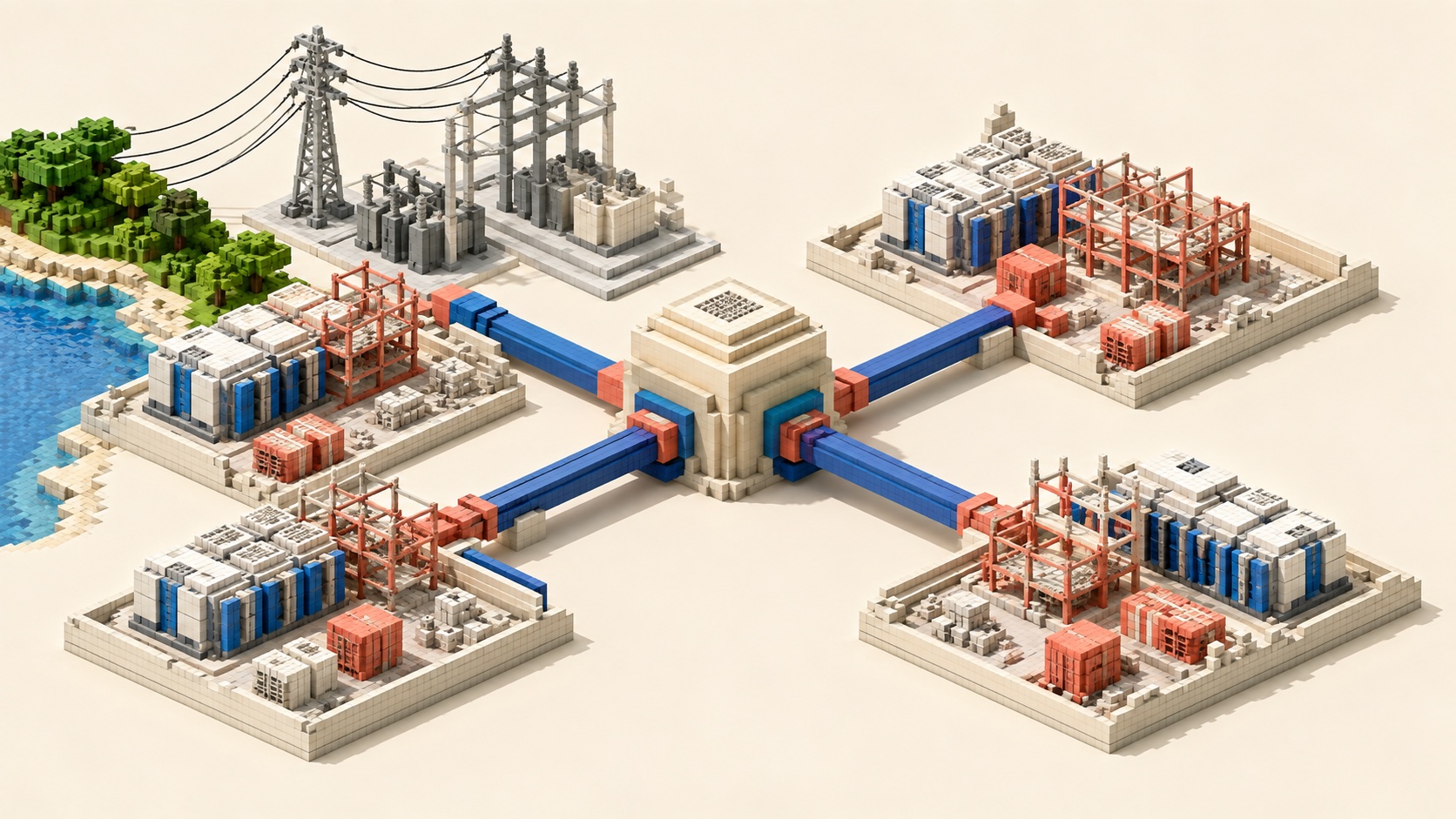
Singapore's second data-center call provisionally allocated 200MW, with four operators receiving 50MW each. Selection removes one obstacle to market entry. It also begins a period in which capital can leave the developer before customer billing starts. A scarce permit has value, but that value does not automatically become shareholder profit. [1]
DC-CFA2 connects selection to greener energy, IT efficiency, AI economic contribution and execution. Customers therefore become part of the development proposition: durable workloads, equipment utilization and local activity help justify the use of constrained electricity. [2]
In this article7 sections
An allocation is an opportunity, not revenue
The original announcement places the projects on Jurong Island and describes the allocations as provisional. Conditions, energy arrangements, design, construction and customer acceptance remain. Allocated capacity cannot be treated as energized, occupied IT load generating a full year of rent. [1]
Equal nominal awards can have different economic value. A project with a qualified customer, defined power procurement and sensible phases may recover capital earlier than one still changing design or seeking demand. The final size can be identical while cash is tied up for very different periods.
Rental estimates first require a capacity boundary. Facility power cannot simply be multiplied by an IT-capacity rental rate. Even an IT award must be separated into contracted, available, installed and billable capacity. Redundancy, PUE and lease definitions affect the denominator.
Screening raises the entry barrier but can raise compliance costs too. Constrained supply may support pricing, while efficient equipment, energy procurement and local commitments absorb part of the scarcity premium. The return is the amount left after those costs, not the award itself.
A valuable customer brings use, credit and efficiency
The application framework considers innovation, talent and wider contribution. It also calls for equipment meeting or exceeding SS 715:2025 and collaboration to improve utilization. Efficient buildings do not by themselves establish that customer servers are productively used. [2]
Long contracts help align construction, specifications and funding. Their financing value depends on payment rights: a customer able to withdraw without cost offers less protection than an enforceable minimum-payment obligation. Rigidity can in turn lead the customer to demand a lower price.
More efficient systems can earn more compute revenue within the same power envelope, potentially supporting higher facility fees. Whether the landlord captures that benefit depends on bargaining power. Required efficiency improvements may chiefly reduce the customer's compute costs rather than expand landlord profit.
Customers can also compare regional alternatives. Work sensitive to latency, data constraints or local connectivity may pay more for Singapore, while portable training or batch work can compare other markets. This is a commercial distinction, not an assumption about the four projects' undisclosed customer mix.
Electricity costs can change the return materially
Consider a hypothetical facility averaging 40MW of IT load at a PUE of 1.25 for 8,760 hours. Annual energy consumption would be about 438,000MWh. A $10/MWh increase in realized procurement cost would add $4.38 million of annual expense. None of these load, PUE or price assumptions represents a selected project's actual economics.
| Illustrative variable | Calculation | Result |
|---|---|---|
| 40MW IT load; PUE 1.25 | 40 × 1.25 × 8,760 | 438,000MWh/year |
| Power cost rises $10/MWh | 438,000 × 10 | $4.38m/year |
| PUE falls to 1.20 | 40 × 0.05 × 8,760 | 17,520MWh/year saved |
An electricity pass-through can protect direct landlord margin, but higher total customer costs still affect renewal and expansion. A fixed all-in service charge can leave more exposure with the operator. Settlement delays can create working-capital pressure even when costs are contractually recoverable.
Certificates, long-term power contracts and reliable physical supply address different needs. Environmental attributes do not independently guarantee hourly delivery. Fixed pricing can come with minimum-purchase or settlement obligations. Policy compliance, supply reliability and economic value each require analysis.
At the same 40MW IT load, reducing PUE from 1.25 to 1.20 saves about 17,520MWh annually. At an illustrative $100/MWh, that is $1.752 million. The investment decision then depends on additional equipment cost, maintenance, useful life and which party retains the saving.
Phasing reduces idle capital at a possible cost
Building everything before customer installation brings interest, depreciation and operating expenses forward. Phasing can align expenditure with billing, although smaller orders, repeated mobilization and reserved interfaces may raise unit construction costs. The appropriate schedule follows customer ramp, rather than a universal preference for the fastest total buildout.
For illustration, consider a $40 million annual operating cash receipt delayed by a year. At a 10% discount rate, moving that same receipt from one year ahead to two years ahead reduces present value from about $36.36 million to $33.06 million, a decline of roughly $3.31 million. This isolates time value and excludes extra interest, construction expense or contractual damages.
Contracts determine the exposure. Customer-caused delay may leave payment obligations intact; a facility that fails acceptance may not collect rent and may owe compensation. Contractor delay damages do not guarantee immediate cash recovery because limits and dispute periods matter.
Funding documents must therefore be read against the schedule. Draw conditions, required equity and cost-overrun support reveal more than a nominal debt commitment. Funding current construction is one problem; rent covering debt and continuing maintenance is the test of the completed investment.
Policy can protect supply while limiting the premium
Staged supply can reduce sudden vacancy and improve the operating environment for credible projects. Existing customer connections and delivery experience may help established operators. That is the favorable case for allocation value, but it does not remove incremental project costs.
Regulators also seek efficient public-resource use and local contribution, rather than the highest possible landlord rents. Excess pricing could push portable demand elsewhere; continuing obligations could absorb surplus. The premium from scarce land, power and permission may be shared by government, energy providers, customers and owners.
Demand may also arrive later than expected. A customer can express durable interest while lacking hardware, workloads or budget for immediate installation. The allocation then provides an option, but committing all capital early magnifies vacancy exposure. Signed payment obligations are more informative than enquiries.
One Singapore program does not establish that other countries will adopt the same policy. Power markets, land systems and fiscal objectives differ. The transferable analytical practice is to separate allocated, deliverable and paying capacity, then assess costs at each stage.
A high rental rate can still produce an ordinary return
A high-rent facility can also carry high land, energy and construction costs. Cheap debt may require stricter reserves or more equity. Comparing same-period operating cash with total invested capital is more informative than ranking rent per kW.
Construction prepayments reduce developer funding needs but require future service. Payment only after acceptance demands longer financing cover. A large advance may secure a customer discount, so accounting profit and funding efficiency can move differently.
Exit value also depends on whether a new tenant can reuse electrical, cooling and network configurations. A highly customized dense design can increase the first lease’s value while narrowing replacement demand. Location and permits remain valuable without guaranteeing recovery of all original investment.
Separate asset cash generation, contractual and financing allocation, and the equity investment required for the residual. That allows scarce Singapore capacity to be compared meaningfully with projects elsewhere that have different costs and delivery schedules.
Compare four project cash flows
Project comparisons require tranche dates and capacity definitions, customer payment terms, energy obligations and pass-through arrangements, and capital and financing requirements. The total award cannot support a credible profit forecast without those inputs.
High contracted use, manageable energy costs and timely delivery would support durable cash generation in a constrained market. Procurement premiums, financing costs and delay could instead consume the rental premium and produce ordinary or weak returns despite scarcity.
The investment question progresses from who receives 50MW to who converts it into profitable customer relationships. Start with billing dates, then deduct energy, maintenance and debt obligations. That is where the award's value to shareholders becomes visible.
Sources
This website is for information and research only and does not constitute investment advice.