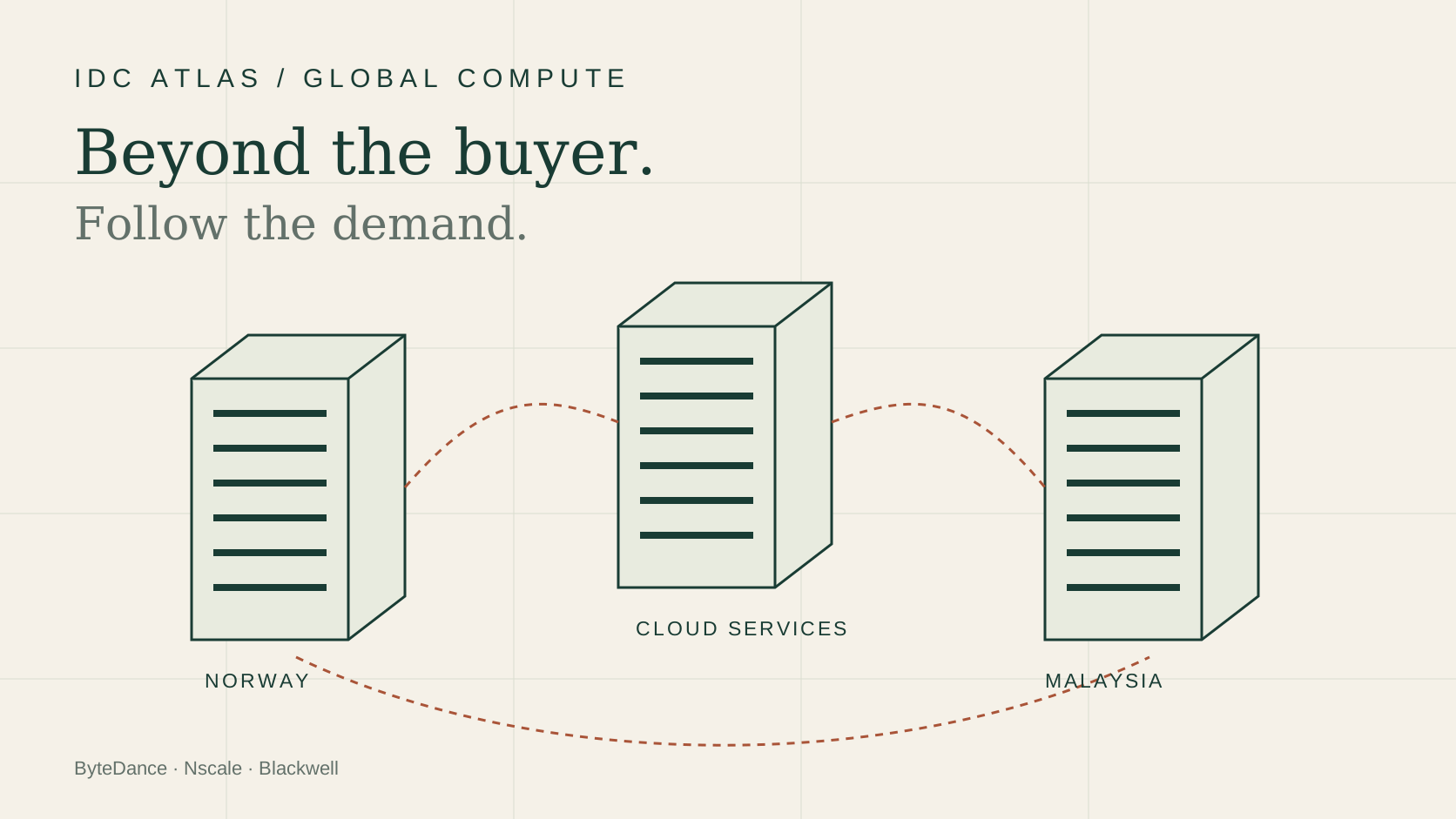
Nscale’s IPO filing reveals a significant overseas computing business. In 2025, one customer generated 73% of the British AI cloud provider’s revenue. The Decoder, citing a Financial Times investigation, identifies that customer as ByteDance. A contract exhibit also names Singapore’s Spring, a Norwegian facility and 2,304 B200 GPUs.[1][2][3]
In the first half of 2026, Nscale’s revenue reached $140.6 million and its largest customer contributed 52%. If that customer was still ByteDance, its implied six-month contribution was about $73.11 million, roughly three times its estimated contribution for all of 2025. A declining share could therefore coexist with substantial growth in absolute revenue contribution. The filing does not confirm customer continuity; that identity assumption underlies the calculation.[1]
That leaves investors with a more useful set of questions. How much equipment purchased by overseas clouds is supported by demand from Chinese application companies? Does identifying the user point to additional orders, or explain shipments already made? Following the contracts through equipment revenue, cloud margins and cash collection shows why one expansion in computing can produce different returns across the supply chain.
In this article7 sections
The customer, the contracting entity and the equipment buyer
Nscale reported $33 million in 2025 revenue, with its largest customer contributing 73%. Multiplying the disclosed figures gives approximately $24.09 million, subject to rounding. That is one provider's annual customer revenue. It is not ByteDance's total overseas compute budget, the value of a multiyear contract or cash paid during the year.[1][3]
The first-half mix is equally important. Nscale reported $140.6 million in revenue, with 52% from its largest customer. Assuming that customer was still ByteDance gives $140.6 million × 52% = $73.112 million, approximately three times the estimated $24.09 million contribution in 2025. The amount is approximate because the disclosed percentage is rounded. This compares six months with the previous full year; it is not a year-on-year growth rate.[1]
The scenario assigns the anonymous first-half customer to ByteDance, whose earlier relationship was identified in reporting. The company has not confirmed continuity. If the largest customer changed, the figures would still show substantial concentration but could not estimate ByteDance’s contribution.
| Period or scenario | Revenue share | Contribution and basis |
|---|---|---|
| Largest customer in 2025 | 73% | About $24.09m; identity attributed to reporting |
| Largest customer in H1 2026 | 52% | About $73.11m; unnamed in S-1 |
| Assume ByteDance remains largest in H1 | 52% (disclosed percentage) | Implied $73.11m, about 3.0× its estimated full-year 2025 contribution |
| FY 2026: largest 2025 customer | Company expects below 20% | Forecast, not the actual full-year share |
Four roles need to be distinguished: the company using the compute, the legal customer signing the service contract, the cloud operating the fleet and the vendors supplying equipment. Those roles may belong to different entities in different countries. A customer can rent capacity while the provider purchases or finances GPUs and arranges the facility, power and operations.
Exhibit 10.12 identifies Spring (SG) Pte. Ltd. as the customer under a cloud-services agreement dated May 15, 2025. The document concerns assets in Glomfjord, Norway, listing 2,304 NVIDIA B200 GPUs alongside 32 NVL72 GB200 systems. Spring's connection to ByteDance comes from FT reporting; the exhibit does not independently establish their ownership relationship. Its equipment terminology also does not support inventing a more specific board configuration.[2][3]
Dividing $24.09 million by 2,304 GPUs would not establish a rental price. The revenue spans a customer's agreements over a year; the equipment belongs to the scope of one exhibit. Nscale describes agreements signed between November 2024 and March 2026 with phased service delivery and acceptance requirements. Equipment scope, service months and revenue periods must align before a per-GPU calculation has commercial meaning.[1][2]
Norway has a contract; Malaysia remains a reported plan
The Norwegian example establishes an identifiable commercial structure: a Singapore entity contracts for services from Nscale, with equipment in Norway. The provider's headquarters identifies the commercial counterparty, the facility locates the physical resources and the eventual user explains the economic demand. Treating all revenue at a European-headquartered provider as European end demand would miss this distinction.
The Malaysian lead is larger but rests on different evidence. On March 12, 2026, Reuters, citing the Wall Street Journal's sources, reported that ByteDance was working with Aolani Cloud on about 500 Blackwell systems containing roughly 36,000 B200 GPUs. The available account describes a deployment plan. It does not establish acceptance and service commencement for the entire fleet.[4]
For a customer, specialist GPU clouds can organize equipment, facilities and operations. Whether rental is better than ownership depends on availability, flexibility, reliability and the cost of completing the workload. Earlier access may justify a higher rental rate if it materially accelerates training or product delivery. When supply is accessible and demand uncertain, a long fixed commitment can become a liability. Public information is insufficient to calculate ByteDance's particular trade-off.
Geographic dispersion also changes what capacity can do. Training needs contiguous resources and fast cluster communication; online inference adds latency and regional coverage. Equal GPU counts can require different networks and achieve different utilization. Norway and Malaysia should therefore have separate contract and delivery schedules. Combining them into 38,304 GPUs already in use would erase an essential distinction.
What the B300 evidence actually supports
The strongest customer-project evidence concerns B200. GB300 NVL72 is a different system generation: NVIDIA specifies 72 Blackwell Ultra GPUs, 36 Grace CPUs and liquid cooling. B200 and B300 are GPU-generation labels, while GB200, GB300 and NVL72 also involve CPUs, rack configurations and interconnects. A chip purchase, a rack purchase and a compute-service contract have different economics.[7]
In July 2026, Nscale disclosed that its 64-rack GB300 NVL72 production cluster at Verne's Keflavik campus in Iceland had completed NVIDIA Exemplar Cloud validation. This supports the provider's operating capability. It does not identify ByteDance as a customer of that cluster.[5]
ByteDance's New York Senior Production System Engineer vacancy supplies a demand-side clue. It covers introduction, integration, deployment validation and production operation of platforms including GB200/GB300 NVL72 and HGX or DGX B200/B300, alongside dense power, liquid cooling and reliability. The vacancy does not disclose a purchase quantity, project location or vendor.[6]
Together, the materials show an available platform and a company recruiting relevant engineering skills. Establishing additional ByteDance B300 capacity would require a customer-specific contract or deployment disclosure with the hardware and service period. Engineering preparation can inform equipment-order research, but a provider's platform still needs customer allocation, delivery and billing before it produces revenue from that customer.
The economic variable is cost per completed workload. Greater hardware throughput can be offset by software adaptation, cross-rack bottlenecks or weak utilization. Rental competition may transfer part of the efficiency gain to customers. B300 can therefore improve customer economics without raising the provider's margin; the model number alone says still less about an individual supplier's earnings per share.
The same GPU plan can produce very different revenue
Million effective GPU hours · illustrative scenarios
Delivery share, service start and billing terms determine how planned equipment becomes revenue. System vendors typically depend on delivery and acceptance; cloud providers need a billable service period; customers need workloads to run reliably. These are distinct financial clocks. An announced GPU count gives a scale reference, not an annual revenue forecast.
An illustrative sensitivity calculation uses the reported 36,000 GPUs: effective annual GPU hours equal 36,000 multiplied by delivered share, fraction of the year in service, 8,760 hours and effective utilization. Each percentage is an analytical assumption. The calculation does not use an undisclosed rental rate or treat observed activity as a contractual billing measure.
Half the equipment operating for six months at 60% utilization yields 47.304 million hours. At 75% delivery, nine months and 75% utilization, the result is 133.0425 million hours. Full delivery for twelve months at 90% utilization produces 283.824 million hours. The first and third cases differ sixfold with the same planned fleet. Service timing and operating conditions drive that difference.
Converting these hours to cloud revenue would require the actual contract. Usage-based billing generally transmits changes in activity to the customer bill. Reserved capacity or minimum commitments can temporarily separate customer usage from provider revenue. GPU hours also cannot be converted mechanically into model performance because communication, memory and software efficiency differ across tasks.
Nscale's financial statements show why demand growth alone does not establish an attractive cloud return. First-half 2026 revenue was $140.6 million, while cost of revenue excluding depreciation and amortization was $189.6 million, a $49 million shortfall before separately reported depreciation, research, administration and financing items. This is a company-level observation, not an estimate of a ByteDance contract's profitability or a mature cluster's unit economics. It nevertheless requires investors to examine ramp costs and fixed expenses alongside fleet growth.[1]
Subsequent progress should be assessed by comparing incremental revenue with incremental operating costs, checking whether the resulting contribution covers depreciation and interest, and determining whether customer payments support further equipment purchases. Sustained improvement would support an investment case for scale. Lower rental rates or delayed service commencement could instead make a larger fleet require more capital.
Which suppliers can retain the economic benefit?
ByteDance's overseas rental activity can support NVIDIA and the surrounding systems supply chain through cloud providers. Any incremental-order analysis must first establish whether the hardware is already included in supplier shipment expectations. A newly identified end user does not create a second sale. Additional quantities, revised delivery dates and order changes are the inputs that can alter near-term earnings.
System builders and integrators depend on production schedules, component availability and acceptance terms. They may record equipment revenue before the cloud earns service revenue over subsequent years. More integration responsibility can also bring warranty costs, support obligations and working-capital needs. Rack revenue growth must be traced through gross profit and collection terms before it is translated into an earnings forecast.
Optical communications merit attention, but every GPU connection is not an optical-module sale. NVIDIA's GB200 NVL72 description distinguishes intra-rack copper from data-center networking; its GB300 NVL72 specifications include 800Gb/s connectivity per GPU. Optical demand depends on cross-rack topology, ports, distance and switching layers. It cannot be calculated from the number 72 alone.[7][8]
Modules, lasers, optical components and switch silicon are different products with different margins. Raising an individual US or Chinese supplier's revenue estimate would require customer qualification, product speed, share and delivery evidence. The appearance of ByteDance or Nscale in a demand story does not establish those inputs.
Power and cooling suppliers face similar allocation questions. Liquid-cooled platforms need appropriate distribution, heat removal and integration, but a new campus and a retrofit carry different equipment content. Direct purchasing and a bundled system contract can change who wins the business. Pricing competition, engineering responsibility and maintenance expenses determine how much of an order remains as profit and cash.
If ByteDance remained the largest customer, what would a falling share mean?
The prospectus expected Nscale's largest 2025 customer to contribute less than 20% of full-year 2026 revenue. That was management's forecast, not a completed annual result. The customer's absolute revenue could increase while its share falls if other customers grow faster.[1]
Under that identity assumption, the numerator and denominator can be separated. ByteDance would account for approximately $73.11 million in first-half revenue and other customers for $67.49 million. The estimated 2025 amounts were $24.09 million and $8.91 million, respectively. The half-year and full-year periods do not support a year-on-year growth calculation, but their scale shows the scenario’s implication: ByteDance’s contribution expanded substantially, while other customers expanded faster, reducing its share by 21 percentage points.
This makes the investment interpretation more specific. For Nscale, a smaller customer share alongside growth in that customer’s business fits the scenario better than spending cuts by ByteDance, although 52% still represents substantial dependence. For equipment vendors, it supports watching ByteDance-linked capacity expansion. It does not establish that all revenue growth came from additional GPUs: more service months, the ramp of previously delivered equipment, pricing and changes in contract scope could also raise revenue.
The below-20% full-year forecast also permits a conditional test. If the largest 2025 customer contributed approximately $73.11 million in the first half, and that revenue is not subsequently reversed, full-year Nscale revenue would need to exceed approximately $365.6 million for this customer’s annual share to fall below 20%. Additional second-half revenue from the customer would raise that required total. This is a conditional lower bound derived from the ratio, not company revenue guidance or a prediction that the forecast will be achieved.[1]
For Nscale shareholders, diversification may reduce the relative influence of one customer, but new contract quality and the capital needed to serve new customers still matter. Equipment vendors care about total purchases and delivery. ByteDance demand analysis needs absolute service spending, renewal capacity and additional projects. A customer-concentration percentage cannot answer all three questions.
The strongest counter-case is that overseas rental growth partly replaces owned capacity or moves workloads between clouds. Such a shift can reallocate supplier revenue without expanding the global GPU market by the same amount. New workloads, procurement substitution and provider share changes need separate treatment to avoid double-counting growth.
Efficiency creates a further two-way effect. Model and software improvements can reduce compute per task while lower costs encourage more tasks. Net resource demand depends on which effect dominates. Even if aggregate usage rises, price competition can restrain rental returns. Equipment volumes, customer value and cloud shareholder returns therefore require distinct forecasts.
What would change the investment view over the next two years?
The evidence supports project-level monitoring of overseas Blackwell demand. Contracts and attributed reporting show how large Chinese application companies can support equipment purchases through overseas clouds. At the original research cutoff, the materials did not establish ByteDance's entire foreign fleet, its rental prices or supplier-level order allocation.
The first useful disclosure would connect the customer, hardware generation and service term. It could turn a B300 engineering lead into an analyzable commercial agreement and distinguish replacement from additional capacity. The second would document Malaysian phase acceptance, power and cooling readiness, and service commencement. These milestones determine equipment vendors' delivery quarters and the number of billable months available to the cloud.
The third would show improving service profitability: revenue growing faster than relevant operating costs, mature clusters producing steadier cash contributions and renewals that do not depend on persistent price cuts. Repeated delays would defer the equipment opportunity. Reliable delivery, renewals and improving service margins would make overseas rental a more durable business rather than a single procurement cycle.
Earnings forecasts should change when new contracts, deliveries or financial disclosures change specific model inputs. Customer identity helps explain demand; quantities, prices, costs and timing determine the investment conclusion.
Sources
- Nscale S-1, September 18, 2026
- Nscale Exhibit 10.12: customer and GPU definitions
- The Decoder citing FT, September 23, 2026
- Reuters citing WSJ, March 12, 2026
- Nscale: GB300 NVL72 in Iceland, July 16, 2026
- ByteDance engineering vacancy, accessed October 8
- NVIDIA GB300 NVL72 specifications
- NVIDIA Blackwell interconnect architecture
This website is for information and research only and does not constitute investment advice.