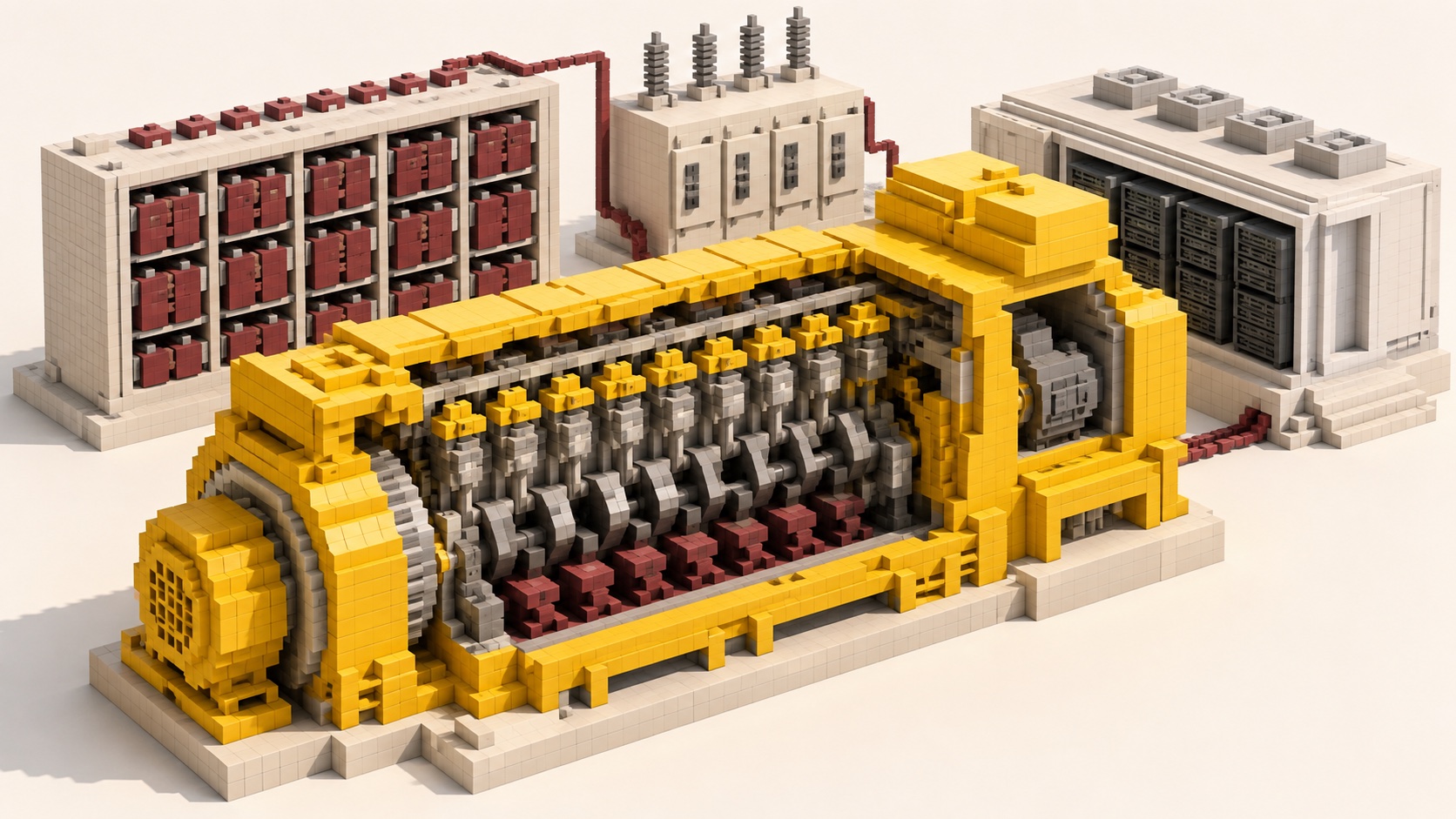
Start with the two figures. Caterpillar's August 4 SEC earnings exhibit reports Power Generation sales of $3.098 billion, up 29% from $2.407 billion. The company says the increase came from large reciprocating engines, turbines and turbine services, primarily in data-center applications.
Total Power & Energy sales were $8.238 billion, up 17%, while segment profit reached $2.027 billion, up 30%. Company sales and revenues were $20.543 billion, up 24%. On the call, management separately cited Power Generation sales to users up 72%, capturing end demand and dealer-channel pacing. The 29% is the exhibit's recognized-revenue view; the 72% is management's measure of the same business at the user layer. Both can be true and should not be merged.
The 29% still carries structural weight. It represents deliverable engines, turbines and service rather than announced campus capacity. Equipment suppliers receive orders before data centers begin billing, making them an earlier read on AI spending moving into power.
The reading is consistent with parallel signals: the Caterpillar-AIP 2GW generator purchase, Partners Group's acquisition of power operator AVK, and hyperscalers adding on-site gas plants all turn power from a cost line into a capital line.
Power equipment has become a growth axis
Power Generation was the fastest-growing major application inside Power & Energy. Oil and Gas and Industrial each rose 9%, showing a much stronger data-center-related power trend. Segment profit grew faster than sales as volume and price more than offset higher manufacturing costs.
The category includes large reciprocating engines, turbines and related services and cannot be assigned entirely to AI data centers. Caterpillar says data-center applications were the primary driver without disclosing customer count, revenue share or equipment mix.
The gap between the call and the 8-K is explained by channel position: the exhibit recognizes revenue on shipments to dealers, while sales to users capture end demand, including inventory drawdowns and restocking. They describe the same trend at different points in the channel, with different timing and magnitude. Keep both figures and label their uses: 29% for comparison with prior filings, 72% for the feel of end demand.
Inside Power & Energy, generation is one application among several, including oil and gas and industrial. Set against that background, 29% is not an industry growth rate; it is data-center applications' excess growth over other end markets.
| Metric | Disclosure | Basis and boundary |
|---|---|---|
| Power Generation | $3.098B / +29% | Led by large reciprocating engines, turbines and services, primarily for data centers. |
| Power & Energy | $8.238B / +17% | Segment profit was $2.027B, up 30%. |
| Company total | $20.543B / +24% | Q2 sales and revenues; adjusted EPS was $8.17. |
| Sales to users (call) | Power Generation +72% | Management figure; captures end demand and channel pacing. |
The next AI dollar splits along the power path
A high-density AI campus needs more than generators. Firm-power systems typically include gas supply, engines or turbines, batteries, switchgear, transformers, controls, emissions treatment, spares and long-term service. Each layer has its own delivery and revenue schedule.
Caterpillar's Monarch project with American Intelligence & Power illustrates the chain. AIP ordered 2GW of fast-response natural-gas generator sets for delivery from September 2026 through August 2027, paired with battery storage for AI load swings. The project targets the first 2GW online in 2027 and 8GW over time.
The 2GW is a purchase and project plan; 8GW is a longer-term objective. Equipment delivery, air permits, gas, commissioning and data-hall load must close before either becomes usable power. An equipment order answers whether the machines exist; project execution answers whether they run.
Hyperscalers add on-site gas plants for the same reason: interconnection queues, grid capacity and continuous availability set when compute comes online, so generation assets become part of campus financing and delivery plans.
- 01Equipment orders arrive first
Engines, turbines and storage can create revenue and backlog before campus operations.
- 02Fuel and permits control delivery
Gas capacity, emissions modeling, controls and local approvals determine continuous operation.
- 03Storage handles load variation
Fast AI-rack power swings require coordination across generators, BESS and distribution controls.
- 04Service extends cash flow
Continuous-duty operations create spares, maintenance and field-support demand after installation.
Speed and modularity explain the opportunity
Large turbines offer efficient scale, while reciprocating engines can arrive in modules, start quickly and expand with campus phases. The Monarch announcement says G3516 units can move from zero to full load in about seven seconds. That is a project and vendor specification; real system behavior depends on configuration.
Technology selection is not a single best answer: turbines win on efficiency and scale, reciprocating engines on speed and modularity, batteries on millisecond response, while grid and gas cover base load. Campuses typically combine generators, storage and grid or gas rather than betting on one technology.
Modularity shortens the construction path and increases unit count, maintenance and fuel-management complexity. Long-term islanded operations need redundancy, black start, spares and emissions controls; grid-parallel systems add protection and dispatch.
The capital path has two layers. Rapid generation and storage answer when power arrives. Grid, fuel and service answer whether it runs reliably at sustainable cost. The first creates orders; the second determines project returns.
Purchase is not operation
Track separate dates for order, delivery, commissioning and commercial operation.
Is gas capacity secured?
Generator count still depends on long-term contracts and pipeline capacity.
Is the air permit final?
EPA clarification does not remove state permitting, controls or monitoring.
Does recurring service follow?
Field support, spares and availability determine cash after equipment sales.
Four gates between order and operation
Generation revenue recognizes at delivery; campus compute revenue recognizes after energization. The gap between them is project execution: equipment arrival is the first gate, while air permits, gas connection, commissioning and customer load decide when the machines run continuously.
The EPA has clarified the permitting boundary for data centers: federal clarification does not remove state-level permitting, emissions controls or monitoring obligations. For project teams, generator count does not matter until emissions modeling, control equipment and local approvals close.
AIP's delivery window runs from September 2026 to August 2027, spanning three quarters. For the equipment maker it is a revenue recognition schedule; for the campus it is a capacity ramp; for the cloud tenant it is the arrival time of usable compute. The same calendar reads differently to each observer.
Each gate is verifiable: orders and delivery appear in announcements and 8-K filings, air permits in EPA and state records, gas connection in pipeline agreements, commissioning and energization in project announcements. Until all four close, a campus sits in purchased-but-not-operating status.
- 01Equipment delivery
Engines, turbines and storage arrive per contract, creating equipment revenue.
- 02Air permitting
Emissions modeling, controls and state approvals close.
- 03Gas connection
Pipeline capacity and long-term fuel contracts are secured.
- 04Commissioning and energization
Grid sync, load testing and customer load precede billing.
How the print maps into the data-center chain
For campus developers, firm power can shorten grid waits and raise upfront capital, fuel and permitting exposure. For equipment suppliers, orders arrive ahead of data-hall revenue and require manufacturing plus field service to keep pace. For cloud companies, power enters the lifetime cost of usable compute.
For competition, Caterpillar's growth shows that large reciprocating engines now have scalable data-center demand, which will draw more suppliers into the off-grid power market; equipment capacity, gas supply and installation labor become the next bottlenecks.
Counter-evidence matters: the Power Generation category includes non-data-center applications, and the mix is undisclosed. If oil-and-gas and industrial growth catch up, or the 2GW project slips, the AI-power-spillover call should be revised down.
Next quarter, watch Power Generation growth, segment backlog, capacity expansion, project deliveries and service revenue. Continued outgrowth versus oil-and-gas and industrial applications, paired with permitted and commissioned projects, would strengthen the AI-power-spillover thesis.
IDC ATLAS VIEWCaterpillar's 29% shows that AI infrastructure has entered heavy industrial equipment. The next dollar goes to generation, storage, distribution and service that keep GPUs on. Fuel, permits and commissioning still separate orders from operating campuses. Keep 72% and 29% as the call and filing measures, label both, and never merge them, so the numbers can carry the analytical weight they deserve.