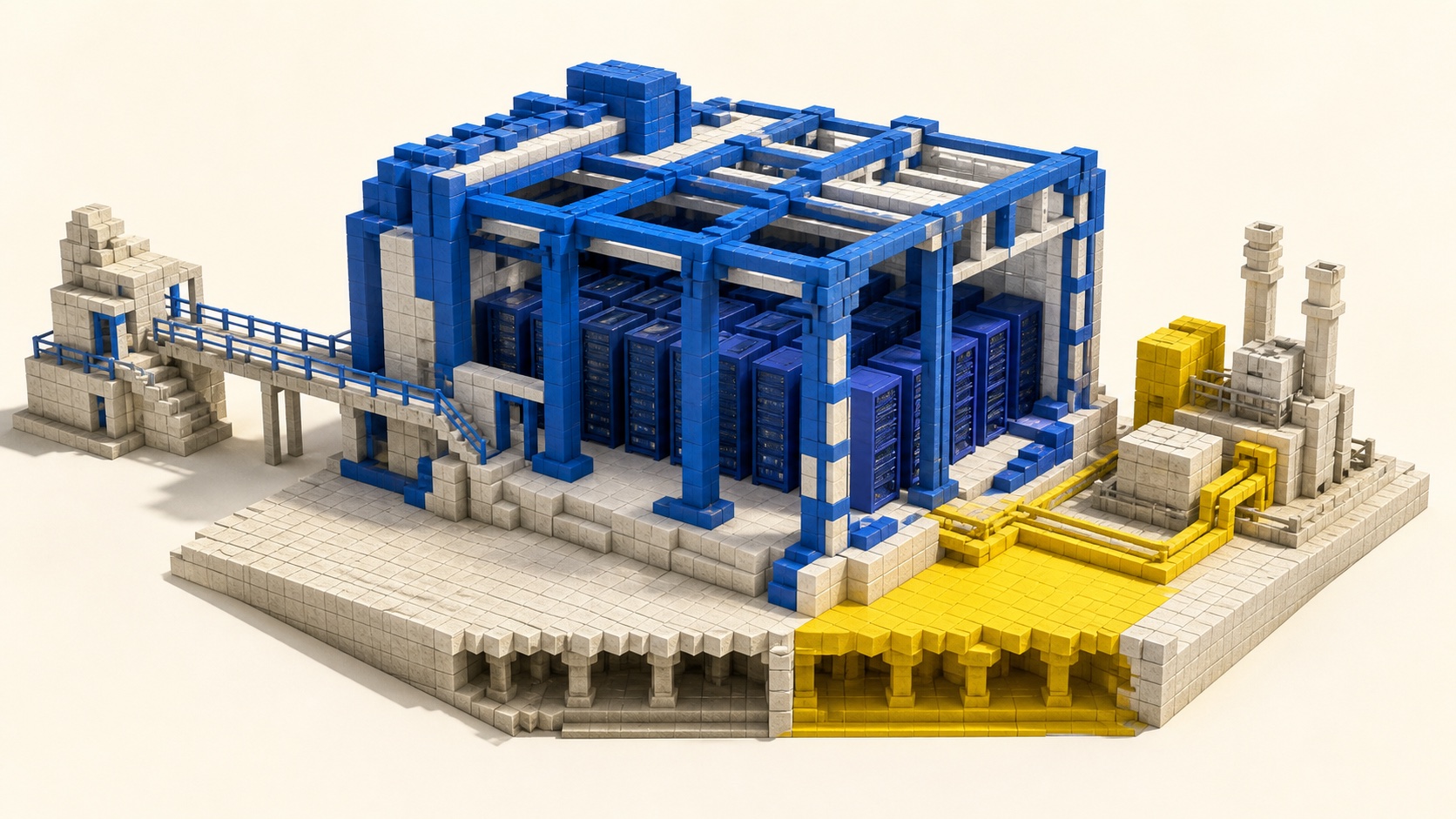
The Commission's current project page says the InvestAI Facility aims to mobilize €20 billion for several AI Gigafactories. An informal expression-of-interest process produced 77 proposals across 16 member states and 60 sites. A formal call is expected in summer 2026, with first construction targeted for 2027.
Broader early estimates use different scopes. The current official formulation is €20 billion mobilized and does not aggregate every potential member-state, EIB and future private commitment. This column uses the traceable Commission figure.
Regulation 2026/150 provides the more important mechanism. The EU can cover up to 17% of total compute-infrastructure capex or pre-purchase equivalent access time. One or more member states must at least match it. The consortium carries the rest of capex and all opex.
Public capital buys control and access
An EU-incorporated consortium operates each AI Gigafactory and may include technology-infrastructure suppliers. The project requires a hosting agreement, a public governance body and annual audits. That governance body must pre-approve third-country access arrangements that may affect EU strategic assets, autonomy or security.
The structure avoids some problems of a wholly government-procured supercomputer. The private consortium retains operational autonomy, while public capital receives defined access time, governance and audit rights. Who uses compute, for how long and inside which security boundary becomes a core asset.
| Metric | Disclosure | Basis and boundary |
|---|---|---|
| Capital to mobilize | €20B | The Commission's current program figure for several AI Gigafactories. |
| Expressions of interest | 77 / 60 sites | Across 16 member states; proposals are not selected projects. |
| EU support ceiling | 17% of capex | Or equivalent access-time purchase; states match and the consortium carries the balance plus opex. |
A construction target cannot solve utilization
A facility can be technically full and economically inefficient. Public research, startups, industrial customers and model labs require different duration, security, software and service levels. Queue design determines whether high-value workloads keep entering the machines.
Pre-purchased access secures baseline demand and can also create unused allocation. Projects need a mechanism to move public time without weakening security and let private customers fill open capacity. Otherwise public money shifts utilization risk from construction into operations.
Power adds another constraint. The regulation requires energy, water and sustainable supporting infrastructure. High power prices, interconnection waits and cross-border data rules narrow the site list; multi-site facilities require very high-bandwidth networks to operate as one technical entity.
- 01Public access forms baseload
EU and member-state capital buys access time, which needs transferable, auditable scheduling.
- 02Private customers raise marginal utilization
Industrial, model and cloud workloads monetize open capacity through price and service levels.
- 03Energy and networks shape geography
Multi-site designs need high-bandwidth links; power, water and permits determine deliverable scale.
- 04Upgrade cycles set long-run cost
Silicon turns faster than data halls, so existing power, cooling and networks must accept new compute.
Sovereign control still depends on imported silicon and software
The EU expects predictable demand from Gigafactories to stimulate domestic AI-chip design and, over time, manufacturing. Initial facilities may still rely on non-EU accelerators, HBM, networking and software. Procurement rules can improve transparency and security; they cannot instantly close product and supply gaps.
Three sovereignty layers should be tracked separately: EU entities control the facility and access rules; data and workloads run inside a European security boundary; and a rising share of critical compute is designed or made in Europe. Contracts can establish the first two faster than the industrial cycle can deliver the third.
Who gets compute time?
Annual audits should expose allocation, actual use and unused public access.
Are workloads persistent?
Watch repeat demand from industry, model labs and public research.
Is supply dependence falling?
Keep EU-controlled facilities separate from EU-made compute components.
Can opex remain affordable?
Power price, PUE, water and interconnection govern operations after construction support.
The formal call will contain the investable signal
The procurement must specify consortium, site, power, compute performance, public access, third-country control and upgrade mechanisms. Until those elements are awarded, the initiative is a policy framework rather than an equipment order or construction start.
The useful comparison will be customer design and utilization, not the number of winning countries. A closed loop between public access, private workloads and upgrades can create durable shared compute. A one-time purchase would return opex and refresh cost to public budgets quickly.
IDC ATLAS VIEWEurope's €20 billion plan buys infrastructure control, public access and strategic option value. Success depends on private consortia carrying the remaining capital and opex while filling the same machines with public allocations and commercial workloads.