LG Electronics has moved closer to an important purchasing decision in AI infrastructure. On September 22, the company said its 2.6MW coolant distribution unit had qualified as NVIDIA DSX Ready. Five days later, ETNews reported that LG had gained Preferred partner status in NVIDIA Partner Network’s Power and Cooling category. NVIDIA’s public directory confirms the category; the tier remains attributed to the report of LG’s statement.[1][2][5]
The investment question is how this qualification system changes competition. Common requirements can make it easier for customers to select equipment, while bringing more suppliers into the same procurement pool. LG has improved its opportunity to compete. Its eventual profit will depend on order pricing, scope of supply, engineering costs and execution. The announcements do not disclose customer contract values resulting from the qualification.
In this article6 sections
A common starting point for equipment selection
NVIDIA launched DSX Ready on September 21 with two initial categories: battery energy storage systems and coolant distribution units, or CDUs. LG Electronics, LiquidStack and Vertiv were the first CDU suppliers named. Qualification applies to particular offerings, rather than an entire company or cooling portfolio.[3][4]
That distinction explains why LG’s two announcements belong together. NPN provides a relationship and discovery channel; DSX Ready establishes that a product meets the applicable requirements. One helps buyers find a supplier, while the other offers a starting point for technical assessment. Site design, delivery, pricing and contractual responsibility still determine actual procurement. A directory position provides no basis for estimating order share.
SimReady is another separate designation. Eaton, Schneider Electric, Siemens, Trane and Vertiv contribute equipment assets for simulation in the DSX reference design. Such assets help engineers assess a system before construction. They do not establish that each contributor holds DSX Ready CDU qualification.[6]
| Designation | Scope | What remains unestablished |
|---|---|---|
| NPN Power and Cooling | Partner relationship and discovery | Customer purchases and order share |
| DSX Ready CDU | Applicable requirements for a particular product | Portfolio qualification and site acceptance |
| SimReady | Equipment assets for design simulation | Equivalent CDU product qualification |
Company comparisons should therefore begin with the product being sold: cold plates, connectors, CDUs, chillers or a broader system. Customers, selling prices, service obligations and potential revenue differ across those businesses. A single list of cooling beneficiaries obscures those differences and can encourage investors to assign the same economics to quite different contracts.
What a 2.6MW rating means for a customer
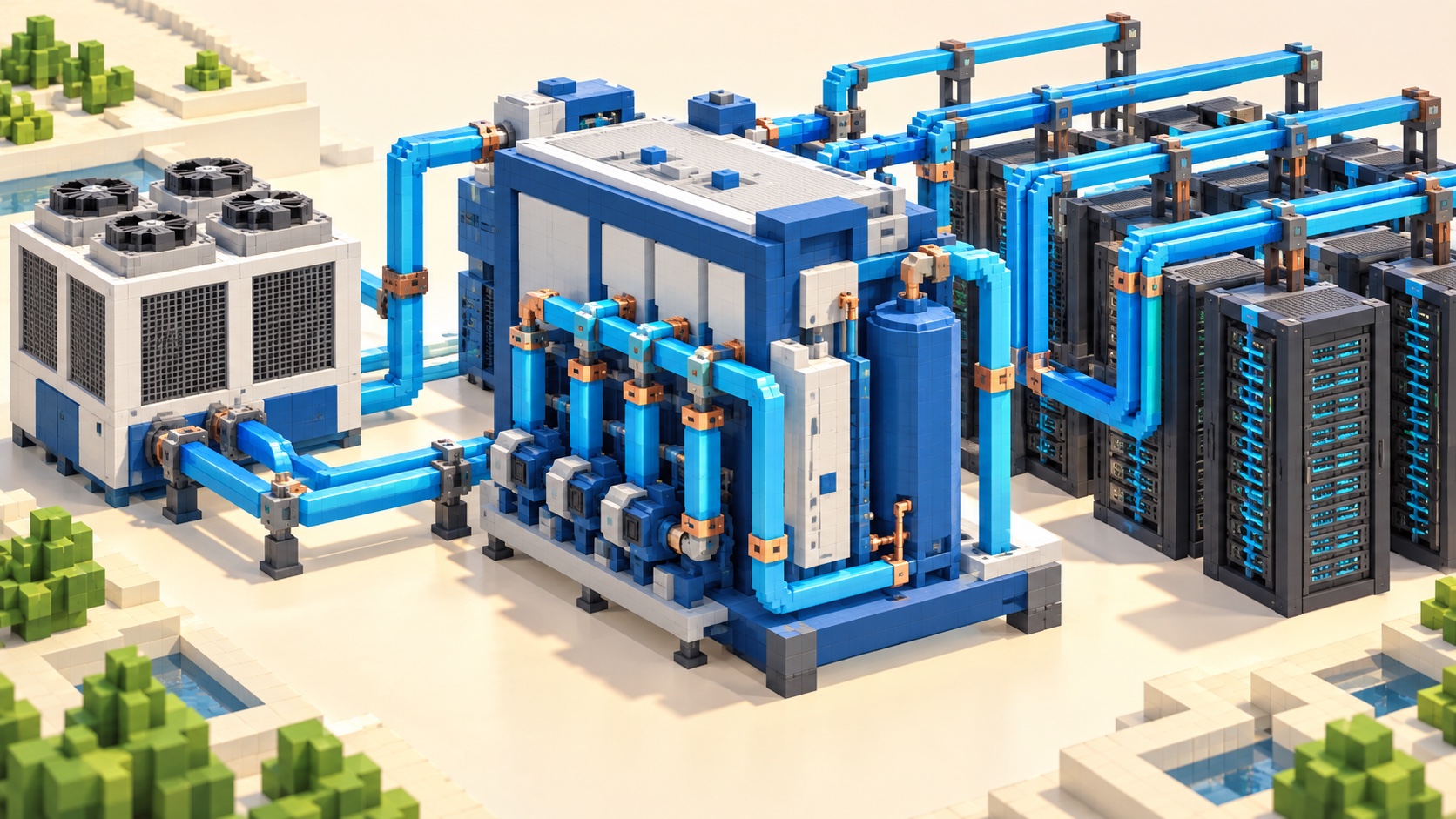
A CDU sits between the server liquid-cooling loop and the facility’s cooling infrastructure. It circulates coolant and manages flow, temperature and pressure. Heat travels from chips through cold plates, pipes and the CDU to the facility cooling system. A mismatch anywhere along that path can limit dependable operation, which is why customers assess the system as a whole.[4][5]
LG’s new DSX Ready designation covers its 2.6MW model. The company also says its 600kW and 1MW units had completed infrastructure qualification. Both the ratings and the scope of validation should be read separately. The 2.6MW figure describes a product’s designed cooling capacity; it supplies no count of units sold or data centers already operating.[5]
For a buyer, a larger CDU may offer centralized management of several high-density rack groups and simplify some interfaces and physical arrangements. The trade-off can include a larger impact from a single failure and additional redundancy requirements. Workload patterns, maintenance, available space and backup capacity influence the final design. A larger nameplate rating does not by itself establish a lower total project cost.
Consider a hypothetical project requiring 10MW of effective heat removal. Dividing 10 by 2.6 produces only a theoretical capacity ratio. Engineers must still allow for reserve units, performance under actual conditions, phased construction and the redistribution of loads during maintenance. That division cannot be treated as a unit-order forecast, then multiplied by an undisclosed price to produce supplier revenue.
Reducing repeated design and commissioning work can create real customer value. Whether a supplier captures that value through higher prices depends on the buyer’s assessment of the savings and the availability of competing products. Technical usefulness and supplier profit are connected through a commercial negotiation, rather than through the qualification announcement alone.
Revenue growth needs a margin and cash-flow explanation
An equipment business can be analyzed through unit sales and realized prices. A broader system contract also requires a breakdown of equipment, installation and service. Forecasting LG, LiquidStack or Vertiv would require their actual contracts and relevant financial disclosures. These announcements provide neither the prices and volumes nor the project margins needed for a company earnings estimate.
Scope of supply matters first. A company delivering only a CDU may record less revenue than a full-system provider, while accepting fewer engineering and warranty obligations. Selling a wider range of equipment can increase revenue per project and also raise procurement, installation, commissioning and management costs. A higher revenue share and a better margin are separate propositions.
Scale has competing effects. Reusable designs, purchasing volume and stable production can reduce unit costs. Rapid capacity expansion, customization and expedited delivery can increase them. If product architecture changes faster than manufacturing ramps, research and requalification costs may arrive before the expected efficiency gains. Industry demand growth alone cannot establish which effect dominates.
Cash flow offers another test. A manufacturer may purchase materials, produce equipment and ship it before collecting payments tied to contract milestones. Customer advances can fund part of that cycle; longer payment terms can increase receivables. Even rising gross profit may coexist with cash absorbed by inventory, receivables and new factories. Comparing orders, sales and operating cash flow helps explain where the funding burden is accumulating.
After-sales service can produce continuing revenue, but it should not automatically receive the economics assigned to a high-margin subscription. Coverage, contract duration, spare-parts obligations and failure compensation determine cost. A growing installed base creates both a sales opportunity and a need for technicians, parts and local support. Renewals, service revenue and actual costs would establish whether that base earns a durable return.
Common standards can help entrants and strengthen buyers
DSX Ready can reduce part of the customer’s screening and integration work. That benefits suppliers seeking new projects: buyers can start from common requirements and narrow the issues requiring separate validation. For companies selling several equipment categories, participation in early design discussions could also lead to a wider scope of supply.
Common requirements can increase comparability too. Once several products satisfy basic technical conditions, buyers can focus competition on price, delivery, efficiency, repair response and contractual responsibility. A larger roster improves supply flexibility and may reduce the premium enjoyed by early qualified vendors. Durable advantage depends on what remains difficult to replace after qualification becomes more widely available.
Integration and service coverage are two capabilities to examine. When several vendors supply a cooling system, interface problems and responsibility for failures can increase coordination costs. A supplier able to accept broader responsibility may win on delivery reliability. It also needs the engineers, spare parts and financial resources to honor that commitment. Portfolio breadth alone is insufficient.
LG’s combination of chillers and liquid-cooling equipment creates a possible cross-selling opportunity. That is an analytical hypothesis based on its product range. The announcement does not establish that customers have expanded procurement. Changes in the shares of Vertiv, LiquidStack or other vendors likewise require named projects and operating evidence. Selection of three suppliers says little about their eventual relative success.
For equity analysis, qualification improves a commercial opportunity before it establishes incremental profit. If a valuation already assumes strong growth and margins, subsequent orders must support that implied performance. This article has no comparable valuation set or market consensus as of its original research date, so it makes no claim that any of the shares is inexpensive.
Equipment suppliers and cloud operators earn on different schedules
Equipment orders can precede a data center’s opening. A cloud operator generally needs to meet the relevant service requirements before earning the corresponding revenue. Cooling connects those stages: delivery of equipment completes only part of the work, while installation, commissioning and customer acceptance can still determine when computing becomes billable.
Contract terms allocate the resulting risk. A supplier responsible for performance acceptance may incur further costs during delayed commissioning. If equipment has been accepted and the facility is delayed for another reason, more of the financing burden may remain with the owner. These differences make a broad statement about strong AI demand an inadequate explanation of earnings across the supply chain.
NVIDIA explicitly retains the need for site-level engineering. Water quality, facility configuration, maintenance and redundancy require their own assessment. Product qualification and achievement of a project’s operating targets must therefore be analyzed separately. That separation explains why technical announcements, equipment revenue and cloud revenue may appear in different quarters.[3][4]
In a favorable scenario, repeated use of validated configurations shortens design and commissioning for subsequent sites. Suppliers deliver more efficiently and operators start billing sooner. In the opposite scenario, power, construction or customer ramp-up continues to delay projects. Mature cooling technology cannot solve those constraints alone. Deferred equipment collection, changing order schedules and rising supplier inventory would then deserve closer attention.
The disclosures that would change an earnings assessment
Named customers, delivered models, contract scope and delivery dates would be the most useful next disclosures. Together they turn a sales opportunity into a project with an estimable revenue schedule. When a supplier mentions total site capacity, investors still need to establish how much equipment it actually supplies. The entire campus investment cannot be assigned to one vendor.
The second category is financial: relevant segment sales and margins, order conversion, inventory and receivables. Revenue growth accompanied by stronger cash collection would support the view that expansion is financially manageable. Orders growing quickly while inventory and receivables grow faster would call for an explanation involving construction delays, advance stocking or changes in payment terms.
The third is operational: actual heat load, cooling power consumption, failures and maintenance. Customer records need to support claims of reduced integration risk. Consistent reliability and efficiency improvements would give buyers a reason to order again, potentially turning an early qualification into a lasting commercial advantage.
As of September 27, the supported conclusion is that LG has improved its opportunity to participate in procurement for NVIDIA-aligned infrastructure, while DSX Ready has made the scope of product qualification clearer. Orders, profits and cash returns must follow through separate stages. The useful investment question is which suppliers can turn qualified products into a repeatable, profitable delivery business.
Sources
- NVIDIA partner directory, accessed September 27, 2026: LG Electronics is listed under Power and Cooling. The directory gives no order or delivery volume.
- ETNews original report, September 27, 2026, attributes Preferred status in NPN Power and Cooling to LG Electronics; the accessible NVIDIA directory does not itself show the tier.
- NVIDIA DSX Ready announcement, September 21, 2026: initial qualified CDU solutions come from LG Electronics, LiquidStack and Vertiv; qualification is product and category specific.
- NVIDIA DSX Ready program page: qualification applies to a specific offering, not a whole company or portfolio; site engineering remains separate.
- LG Electronics release, September 22, 2026: its 2.6MW CDU is DSX Ready; 600kW and 1MW models passed infrastructure qualification. Ratings are not installed capacity.
- NVIDIA DSX reference-design announcement, March 16, 2026: Eaton, Schneider Electric, Siemens, Trane and Vertiv provide SimReady equipment assets. This is distinct from DSX Ready CDU qualification.
- NVIDIA Blackwell ecosystem announcement, June 2, 2024: cooling equipment and component suppliers were already part of its AI factory ecosystem, so 2026 is not cooling's first inclusion.
This website is for information and research only and does not constitute investment advice.