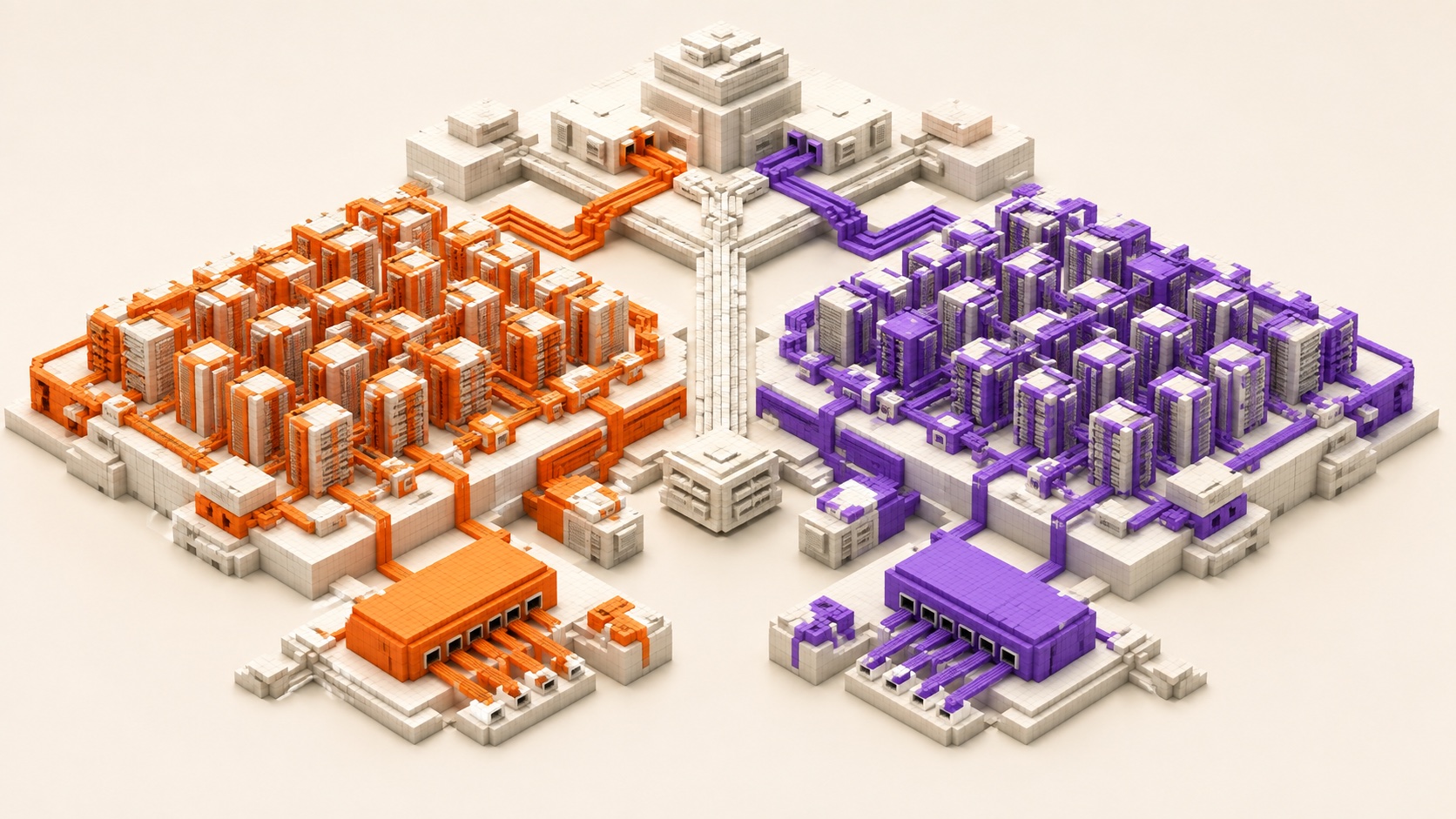
SpaceX's Form 10-Q provides the useful baseline. Nameplate compute draw reached 1.4GW on June 30, 2026, from 0.4GW a year earlier. The metric counts installed GPUs at all-in equipment power and excludes cooling, distribution losses, lighting and facility overhead, so total campus load is higher.
The filing also shows $28.476 billion of property, plant and equipment purchases in the first half. Gross servers and networking equipment reached $34.771 billion, data-center infrastructure $3.991 billion and construction in progress $12.554 billion. SpaceX has moved into a phase constrained by power, construction and system delivery.
Axios reported that management said new AI infrastructure would be built exclusively on NVIDIA Vera Rubin. That supplier statement is a media account of the call, not a line in the 10-Q. This column treats it as a reported management plan and does not extend it to every historical cluster.
Put the two disclosed buildouts on comparable footing
AMD reported record Q2 revenue of $11.536 billion. Data Center revenue was $6.7 billion, up 107% year over year. Management said Helios had begun to ramp and customer deployments of the MI450 family were expanding. The financials show that AMD's data-center business has moved beyond pilot revenue; the 2GW agreement still depends on future delivery.
The AMD-Anthropic agreement covers up to 2GW of MI450-series GPUs, with the first 1GW beginning deployment in the first half of 2027. Helios combines MI455X accelerators, EPYC Venice CPUs, Pensando networking and ROCm. AMD also committed to a future strategic equity investment of up to $5 billion in Anthropic, linking hardware procurement, software work and capital.
| Metric | Disclosure | Basis and boundary |
|---|---|---|
| SpaceX installed compute | 1.4GW | Nameplate compute draw at June 30; facility overhead is excluded. |
| SpaceX first-half PP&E purchases | $28.476B | Covers data centers and related infrastructure as well as launch facilities. |
| Anthropic / AMD | Up to 2GW | The first 1GW is scheduled to begin deployment in the first half of 2027. |
Cluster standardization matters more than portfolio diversification
An AI lab can buy NVIDIA, AMD and custom ASICs without splitting one training job freely across all three. Large jobs require consistent accelerator behavior, communication topology, recovery procedures and compiler environments. Moving across platforms reopens model validation, kernel work, collective tuning and operations training.
Anthropic says diversified hardware lets it map the right workloads to the right hardware. That describes portfolio allocation: separate clusters can carry separate workloads. It does not establish frictionless movement of one training run between GPU stacks.
SpaceX represents the other path. With 1.4GW already installed, one next-generation standard can reduce software branches, spare-part variety and network debugging. Procurement leverage and supply concentration become the tradeoff.
- 01Accelerators set rack density
GPU count, power and interconnect determine busways, cabling and liquid-cooling loops. Silicon becomes a rack-engineering decision.
- 02Networks define cluster boundaries
Vera Rubin and Helios bind networking, CPUs and system software. At scale, topology and failure domains are expensive to redesign.
- 03Software creates usable compute
Installed GPUs create nameplate capacity. Compilers, kernels, scheduling and model adaptation determine how much enters production.
- 04Operations extend lock-in
Spares, field service, monitoring, staff skills and capacity planning accumulate around a platform over multiple years.
AMD must prove delivery; NVIDIA must defend the value of system consistency
AMD's test has shifted from chip specifications to system execution. A 1GW starting tranche requires racks, networking, CPUs, memory, optics, distribution and cooling to arrive together. A delay in any layer can leave the 2GW headline as an unfilled ceiling.
NVIDIA's advantage now extends beyond device performance. If Vera Rubin's rack, network and software stack shortens time to service, customers may pay for consistency. SpaceX's rapid growth in construction in progress gives that claim a real delivery environment.
For the data-center chain, the useful readout is not the identity of one winning supplier. Actual energization, rack density, network design, cooling and availability determine when revenue is recognized and whether campus capacity becomes billable compute.
Does the first 1GW start on time?
Watch for 2027 Helios deliveries, ROCm optimization and explicit Anthropic production workloads.
Vera Rubin time to service
SpaceX needs to disclose installed capacity, availability and the next power step, not only a vendor name.
Nameplate versus facility load
The 1.4GW metric excludes cooling and distribution overhead. Campus load, PUE and energization still govern conversion.
Media call report versus filing
The exclusive NVIDIA plan is reported by Axios. The 10-Q confirms scale and capital spending, not the supplier choice.
Four disclosures can overturn or confirm the thesis
First, SpaceX must keep raising nameplate compute and transfer construction in progress into servers, networking and data-center infrastructure. Second, Anthropic's first 1GW needs to enter deployment on schedule.
Third, AMD must show material Helios revenue and customer activation. Fourth, either company would need to disclose workload allocation, migration cost or utilization across platforms. A miss on any of these points can weaken the portfolio-diverse, cluster-standardized view.
IDC ATLAS VIEWAccelerator competition is becoming a contest between cluster operating systems. Customers will keep a second supplier, but a gigawatt-scale cluster still needs a clear engineering standard. Delivery, energization and sustained availability will settle the argument.