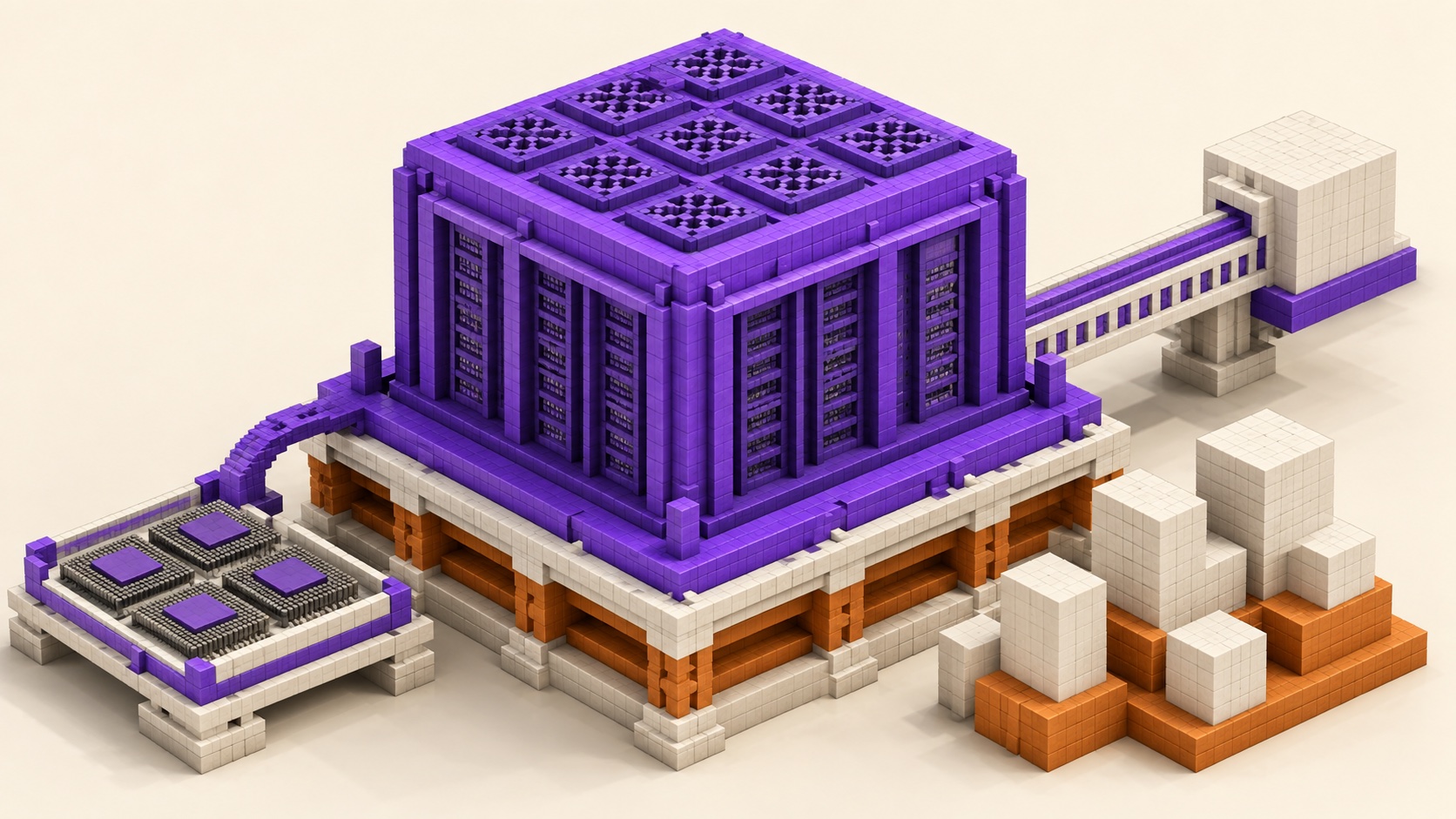
Broadcom, Apollo and Blackstone launched the AI XPV Platform in June 2026. The initial $35 billion capital solution supports more than 1GW for Anthropic, expected to deploy at Fluidstack-based sites beginning in mid-2026. The platform is designed to enable more than 20GW of Broadcom XPU and networking capacity through 2028.
The announcement calls it a repeatable framework. It widens the funding base to insurance capital and private credit, but it does not disclose complete asset ownership, customer minimums, residual-value support, termination rights or unit cost by gigawatt.
Apollo president Jim Zelter later described the initial financing as five-year amortizing paper and emphasized downside and residual-risk control. That is a public management description rather than a published contract. This column analyzes the mechanism without inventing undisclosed guarantees.
$35 billion cannot be divided cleanly by 1GW
The initial solution spans custom Broadcom XPUs, networking, site deployment and financing. Dividing $35 billion by 'more than 1GW' overstates unit build cost because the envelope may include equipment, construction financing, interest reserves, expansion options and several sites.
The 20GW figure is a platform objective through 2028, not contracted, energized or billed capacity. An individual project becomes deliverable only when equipment orders, sites, customer commitments and closed financing are present together.
| Metric | Disclosure | Basis and boundary |
|---|---|---|
| Initial capital solution | $35B | Led by Apollo with Blackstone; full layering and guarantees are not public. |
| Initial compute | More than 1GW | For Anthropic at Fluidstack-based sites beginning in mid-2026. |
| Platform objective | More than 20GW | A 2028 enablement target, not signed capacity. |
Credit travels from model demand into data-center assets
Four layers have to work together. Anthropic supplies long-term demand; Broadcom supplies a custom XPU and network roadmap; Fluidstack deploys the sites; Apollo and Blackstone translate contracts and equipment into debt cash flow.
Anthropic reduces the need to own every asset up front, while Broadcom gains funded orders. Lenders receive scheduled amortization and accept that the technology turns much faster than conventional infrastructure.
- 01Demand commitments support revenue
Minimum use, payment duration and counterparty credit determine amortization; the detailed terms are not public.
- 02The roadmap sets residual value
Custom XPUs and networks have a narrower secondary market than general servers. Early obsolescence lowers recovery.
- 03Site delivery controls timing
Power, cooling, networking and data-hall delays leave purchased equipment waiting while interest and depreciation accrue.
- 04Private credit absorbs the mismatch
Five-year amortization shortens exposure, but customer payments, asset disposition and refinancing still have to align.
Unused capacity and generational obsolescence are hardest to price
A long-term compute contract can lock in nominal demand without guaranteeing hourly utilization. Model efficiency, lower inference prices or workload migration may reduce renewal value even when the customer keeps paying. Flexible termination terms would return risk to the project company and lenders earlier.
Residual value is the second variable. Data halls, power and cooling can operate for more than a decade; custom accelerators have shorter economic lives. The project needs substantial early cash recovery or an upgrade path that reuses the facility.
Concentration is the third. The first project depends on Anthropic, Broadcom and Fluidstack acting together. Public information does not establish substitution rights or loss allocation if one layer changes.
Customer minimums
Underuse payments, deferral and termination terms determine revenue protection.
Equipment residual
Redeployment range, software compatibility and secondary-market depth set recovery.
Sites and energization
Equipment arriving ahead of the campus increases interest, depreciation and storage costs.
Capital layering
The loss order across senior debt, junior capital, guarantees and insurance money is not public.
Scaling from 1GW to 20GW requires project-level evidence
The next financing headline is not enough. Each project needs a record of site, energization, equipment, customer, contract duration, financing close and commissioned capacity. Platform scale matters only after several projects repeat those milestones.
If five-year amortization recovers most principal inside the hardware's economic life and older data halls accept the next generation, the structure can become a major channel for AI capex. Delays, weak utilization or poor residuals will first appear in private-credit pricing.
IDC ATLAS VIEW$35 billion solves construction funding. It does not solve utilization or residual value. The AI XPV model must show that long-duration compute contracts generate enough cash before hardware ages, while the site remains useful for the next generation.