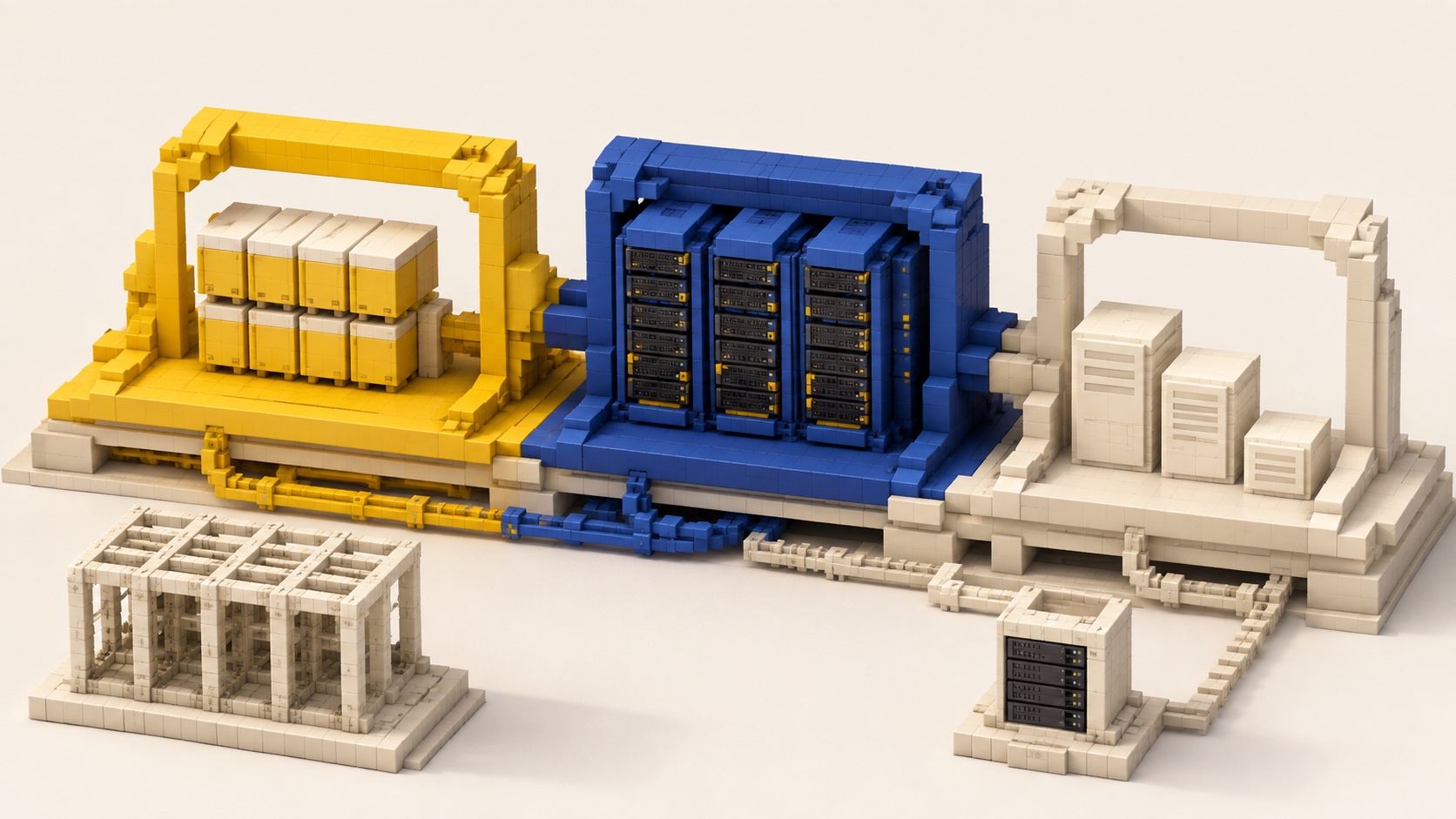
Calling all of these companies neoclouds is convenient but economically imprecise. CoreWeave and Nebius sell GPU cloud capacity to workloads. IREN and Bitdeer are extending existing infrastructure into owned cloud and AI hosting. Applied Digital, TeraWulf, Cipher, Core Scientific and Hut 8 are principally exposed to campuses, IT load, leases and delivery. Chronoscale only separated from Applied Digital in May and does not yet offer a comparable independent reporting history.
The common analytical error is not missing demand; it is skipping the conversion chain. A multibillion-dollar TCV can establish customer credit and a build direction, but it must still pass financing, construction, energization, systems installation, acceptance, billing and utilization ramp. Direct clouds, meanwhile, do not prove full-cycle returns solely with top-line growth: GPU depreciation, technology refresh, financing cost and customer concentration remain behind the income statement.
This column uses company releases, SEC filings and official investor materials only, with an August 12, 2026 Beijing-time cutoff. Formal comparisons cover only customers, capacity, contract duration and financial metrics verifiable in the underlying records.
Separate revenue, ARR, contract value and capacity before comparing the print
CoreWeave reported Q2 revenue of $2.575 billion, up from $1.212 billion a year earlier, and adjusted EBITDA of $1.510 billion. It also disclosed $104 billion of revenue backlog, about 1.5GW of active power and about 3.7GW of contracted power. Revenue, backlog and contracted MW answer different questions: delivered service, signed demand and prospective supply.
Nebius reported Q2 group revenue of $582.3 million, up 454% year over year; AI Cloud was $575 million, up 514%. The company reported 50% adjusted EBITDA margin for AI Cloud and $3 billion of ARR. This is among the closest comparisons to an operating GPU-cloud revenue model, but ARR remains an annualized run-rate rather than recognized quarterly revenue.
The remaining companies occupy earlier or different conversion stages. IREN reported FY2026 Q3 AI Cloud revenue of $33.6 million, up from $17.3 million in the prior quarter. Bitdeer reported Q2 AI Cloud revenue of $14 million and total revenue of $228.8 million. Core Scientific reported $136.7 million of Q2 colocation revenue, with 395MW billing at quarter-end and 437MW by mid-July; billed MW is closer to delivered service than contracted capacity, but it still does not make every signed project current revenue.
| Metric | Disclosure | Basis and boundary |
|---|---|---|
| CoreWeave Q2 revenue | $2.575B | $1.510B adjusted EBITDA; $104B backlog and about 3.7GW contracted power are not current revenue. |
| Nebius Q2 AI Cloud | $575M | +514% year over year; the company reported $3B ARR and 50% adjusted EBITDA margin for AI Cloud. |
| IREN AI Cloud | $33.6M | FY2026 Q3; $17.3M in the prior quarter, an early owned-cloud ramp. |
| Core Scientific billed capacity | 395MW | At 2026 Q2 end; the company said 437MW by mid-July. Billed MW is closer to current colocation service than contracted MW. |
Per-MW contract economics depend on who owns the GPU and utilization risk
Direct GPU-cloud unit economics combine equipment ownership with workload risk. Nebius said in its shareholder letter that new core-cloud contracts carried annualized value above $20 million per MW. That is the company's new-contract metric, not average recognized revenue and not a long-term margin; it reflects a model in which GPUs, networking, software and utilization sit in the same revenue engine.
Hosting contracts can show lower per-MW values while assigning risk differently. Bitdeer disclosed a 121 IT MW, 16-year, $4.7 billion Tydal contract. Dividing $4.7 billion by 16 years and 121 IT MW produces roughly $2.4 million per IT MW per year. This is only a conversion of disclosed total contract value; it excludes discounting, operating cost, financing cost and revenue-recognition timing.
TeraWulf / Justified disclosed 401MW, 20 years and $19 billion. The same arithmetic yields roughly $2.37 million per IT MW per year. It must not be represented as all TeraWulf campuses, all company revenue or operating capacity; the official release confines it to the Justified Atlas campus. Contract value indicates what long-duration capital will pay for deliverable IT load, not that racks, GPUs or cash flow already exist.
| Metric | Disclosure | Basis and boundary |
|---|---|---|
| Nebius new core-cloud contracts | >$20M / MW / year | Company-reported annualized contract-value metric; not average revenue or a margin. |
| Bitdeer Tydal | ~$2.4M / IT MW / year | $4.7B ÷ 16 years ÷ 121 IT MW; IDC Atlas calculation, before discounting, costs or recognition timing. |
| TeraWulf / Justified | ~$2.37M / IT MW / year | $19B ÷ 20 years ÷ 401MW; IDC Atlas calculation, for the Justified Atlas campus only. |
Contracts fix the demand direction; they do not eliminate financing or delivery
CoreWeave's $104 billion backlog establishes the scale of signed demand, not a substitute for server procurement, campus power, financing or customer performance. Nebius's $3 billion ARR likewise depends on accelerator procurement, data-center activation and sustained utilization. Direct cloud reaches the income statement faster but also bears hardware refresh, pricing and idle-capacity risk more directly.
IREN announced $2.8 billion of new TCV in July and a $4 billion ARR target, improving forward visibility while increasing the burden of customer activation and capital deployment. Bitdeer's Tydal contract, Hut 8's 949MW of contracted IT capacity and $26.6 billion of base TCV are inputs to future hosting economics, not recognized revenue. Capacity must retain its state boundary: contracted, under construction, energized, accepted and billing.
Financing is not a side variable. GPU clouds need rapid deployment of servers, networks and working capital. Campus hosts must complete land, power, civil works, transformers, cooling and networking before service revenue. Larger contracts often increase the coordination and front-loaded-capital problem. The best subsequent disclosure puts customer commitment, funding source, energization milestone and actual billing on one timeline.
Revenue arrives sooner; asset risk is more concentrated
Track GPU additions, utilization, unit pricing, depreciation and customer concentration, not revenue growth alone.
Longer contracts create a longer delivery chain
TCV and contracted MW show direction first; energization, acceptance and invoices determine current economics.
Confirm the funding loop before scaling the headline
Contracts do not replace debt, equity, prepayments, equipment procurement or construction cash flow.
Capacity states cannot be collapsed
Contracted, under-construction, energized, system-ready and billed IT MW are distinct operating states.
For mining transitions and campus hosts, the first rent matters more than total capacity
Applied Digital reported $44.1 million of base HPC cloud rent in FY2026 Q4 and $208.2 million of services revenue, including $152.4 million tied to construction and equipment deployment. It disclosed 1,410MW of contracted leases over 15 years and $36 billion of contract value. The analytical task is to separate recurring rent from one-time construction and deployment revenue rather than annualizing $36 billion as current revenue.
TeraWulf reported $31.9 million of Q2 HPC lease revenue and said it had 102MW of revenue-critical IT capacity in early July. Cipher reported $25 million of Q2 revenue and negative $30 million of adjusted EBITDA, with first Black Pearl capacity delivered in August. Both make the same point: entering AI/HPC does not instantly transform the current income statement; initial energization, installation and customer acceptance decide when revenue crosses over.
Hut 8's $72.5 million of Compute revenue combines ASIC, AI and traditional computing services, so it is not a pure GPU-cloud measure. Chronoscale has only been independent since May. For these companies, the most revealing changes are billed IT MW, first-project timing, recurring-rent mix and post-financing dilution—not total power or distant TCV forced into a common valuation multiple.
| Metric | Disclosure | Basis and boundary |
|---|---|---|
| Applied Digital base HPC rent | $44.1M | FY2026 Q4; $208.2M services revenue includes $152.4M associated with construction and deployment. |
| TeraWulf HPC lease revenue | $31.9M | 2026 Q2; 102MW of revenue-critical IT capacity was disclosed for early July. |
| Cipher Q2 | $25M revenue | Negative $30M adjusted EBITDA; first Black Pearl capacity was delivered in August. |
| Hut 8 Compute | $72.5M | A mix of ASIC, AI and traditional compute services, not pure GPU-cloud revenue. |
Over the next 12–24 months, four tests decide who crosses the valuation narrative
First is demand and price: can direct clouds sustain utilization, realized GPU or MW pricing, renewals and customer diversity; can hosts move contracted customers into actual workloads and bills? Second is delivery: a delay in transformers, interconnection, liquid cooling, servers, networking or field commissioning creates a gap between TCV and current revenue.
Third is capital: do equipment deposits, project debt, equity, leases and prepayments cover construction-period cash consumption? Fourth is operations: availability, efficiency, maintenance, customer expansion and redeployment determine whether energized capacity becomes durable cash flow. Each company must produce evidence through these four gates rather than be carried by a single AI-demand narrative.
The conclusion is not that one company must win. Neoclouds are moving from a supply story—who can obtain GPUs or power—to an operating story: who can convert capital, capacity and customer workloads into billed service at the same time. The fastest revenue company does not automatically carry the lowest full-cycle capital cost; the largest contract does not automatically produce the earliest income statement.
- 01Demand and price
Track utilization, realized unit pricing, renewals, customer concentration and whether a contract enters production workloads.
- 02Physical delivery
Track interconnection, energization, racks, liquid cooling, networking, acceptance and billed IT MW; do not substitute total capacity.
- 03Capital closure
Track whether debt, equity, prepayments, equipment procurement and construction cash use remain matched.
- 04Operating conversion
Track availability, efficiency, maintenance, expansion and redeployment to confirm capacity becomes durable cash flow.
IDC ATLAS VIEWThe U.S.-listed neocloud earnings boom is real but heterogeneous. CoreWeave and Nebius demonstrate direct-cloud revenue conversion, while AI/HPC hosts are converting long-term contracts and MW into project cash flow. The next winners will be determined not by a single headline but by revenue quality, delivery discipline, cost of capital and operating execution.